

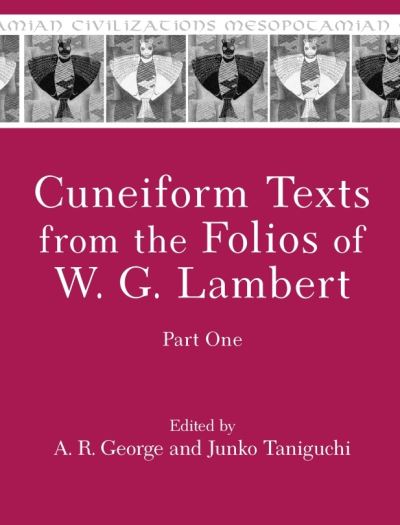
W. G. Lambert's line drawings of cuneiform tablets from the British Museum, together with his meticulous editions of their contents, form a contribution to Assyriology unrivaled in his generation. Upon his death in 2011, Lambert bequeathed his academic legacy to A. R. George, who discovered among its contents approximately 1,400 unpublished pencil drawings. He and Junko Taniguchi took over the task of converting the drawings into images suitable for publication.
The first of two planned volumes, this book features drawings of 329 cuneiform tablets found in Lambert's academic papers. Written by Babylonian and Assyrian scribes between 2500 and 35 BC, the texts in this volume are organized by genre and provided with a descriptive catalogue and indexes. The contents include commemorative and votive inscriptions, late copies of royal inscriptions and royal correspondence, historical and historical-literary texts, Sumerian literature, Akkadian-language compositions of mythological and "epic" content, Babylonian and Assyrian hymns, prayers and praise poetry, incantations, wisdom literature, and fragments of unidentified literary works.
The mass of unpublished cuneiform tablets in museums remains a largely unexplored resource with enormous capacity to illuminate all aspects of life in ancient Mesopotamia. This collection constitutes an important milestone on the road to a fuller comprehension of the written legacy of the ancient Babylonians.
| ISBN: | 9781575067339 |
| Publication date: | 6th November 2019 |
| Author: | W G Lambert |
| Publisher: | Eisenbrauns an imprint of Penn State University Press |
| Format: | Hardback |
| Pagination: | 232 pages |
| Series: | Mesopotamian Civilizations |
| Genres: |
Ancient history |
W. G. Lambert's line drawings of cuneiform tablets from the British Museum, together with his meticulous editions of their contents, form a contribution to Assyriology unrivaled in his generation. Upon his death in 2011, Lambert bequeathed his academic legacy to A. R. George, who discovered among its contents approximately 1,400 unpublished pencil drawings. He and Junko Taniguchi took over the task of converting the drawings into images suitable for publication.
The first of two planned volumes, this book features drawings of 329 cuneiform tablets found in Lambert's academic papers. Written by Babylonian and Assyrian scribes between 2500 and 35 BC, the texts in this volume are organized by genre and provided with a descriptive catalogue and indexes. The contents include commemorative and votive inscriptions, late copies of royal inscriptions and royal correspondence, historical and historical-literary texts, Sumerian literature, Akkadian-language compositions of mythological and "epic" content, Babylonian and Assyrian hymns, prayers and praise poetry, incantations, wisdom literature, and fragments of unidentified literary works.
The mass of unpublished cuneiform tablets in museums remains a largely unexplored resource with enormous capacity to illuminate all aspects of life in ancient Mesopotamia. This collection constitutes an important milestone on the road to a fuller comprehension of the written legacy of the ancient Babylonians.
Cuneiform Texts from the Folios of W. G. Lambert features in the following genres: Ancient history
Cuneiform Texts from the Folios of W. G. Lambert is available in Hardback
Cuneiform Texts from the Folios of W. G. Lambert was written by W G Lambert and published by Eisenbrauns an imprint of Penn State University Press
Cuneiform Texts from the Folios of W. G. Lambert has 232 pages
Yes it is part of Mesopotamian Civilizations series