

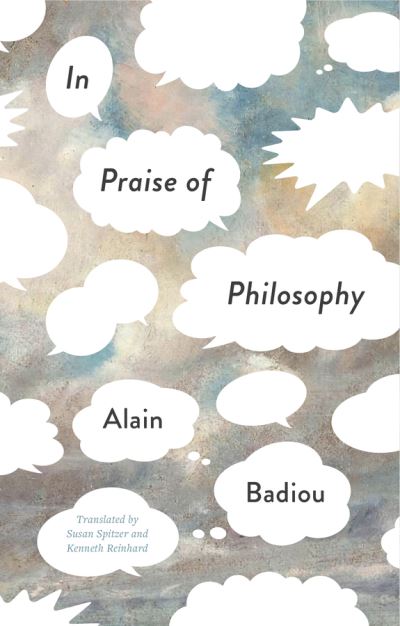
What kind of philosophy do we need for the 21st century? To answer to this question, Alain Badiou imagines a dialogue between Tocéras, an earnest and engaging professor, and various interlocutors from different countries and philosophical cultures - John After from Britain, Amantha from Greece, B'adj Akil from Senegal, Xi La Pong from China and several others. Their conversation takes readers on a playful journey through the history of philosophy framed by the five great questions that have preoccupied Alain Badiou: democracy, freedom, universality, language and being.
At the same time, philosophy is presented not as a system or doctrine but as movement and dialogue. The philosopher is not a solitary figure; he is inseparable from his pupils, his disciples and his adversaries. It is only at the end of the journey that he arrives at the written, stable forms of his work. So we are dealing more with a play than a treatise, more with dialogues than monologues, more with a course than a book. The obvious model is Plato's Socrates, who, in founding philosophy as a discipline, ensured that it could be established anywhere in the world. In praise, yes, of philosophy as the public creation of a thought that, inventing itself and transporting itself anywhere, speaking to anyone about anything, invents the theatricalization of being.
| ISBN: | 9781509565641 |
| Publication date: | 25th April 2025 |
| Author: | Alain Badiou |
| Publisher: | Polity Press |
| Format: | Paperback |
| Pagination: | 202 pages |
| Genres: |
Philosophy |
What kind of philosophy do we need for the 21st century? To answer to this question, Alain Badiou imagines a dialogue between Tocéras, an earnest and engaging professor, and various interlocutors from different countries and philosophical cultures - John After from Britain, Amantha from Greece, B'adj Akil from Senegal, Xi La Pong from China and several others. Their conversation takes readers on a playful journey through the history of philosophy framed by the five great questions that have preoccupied Alain Badiou: democracy, freedom, universality, language and being.
At the same time, philosophy is presented not as a system or doctrine but as movement and dialogue. The philosopher is not a solitary figure; he is inseparable from his pupils, his disciples and his adversaries. It is only at the end of the journey that he arrives at the written, stable forms of his work. So we are dealing more with a play than a treatise, more with dialogues than monologues, more with a course than a book. The obvious model is Plato's Socrates, who, in founding philosophy as a discipline, ensured that it could be established anywhere in the world. In praise, yes, of philosophy as the public creation of a thought that, inventing itself and transporting itself anywhere, speaking to anyone about anything, invents the theatricalization of being.
In Praise of Philosophy features in the following genres: Philosophy
In Praise of Philosophy is available in Hardback, Paperback
In Praise of Philosophy was written by Alain Badiou and published by Polity Press
In Praise of Philosophy has 202 pages
£14.39