

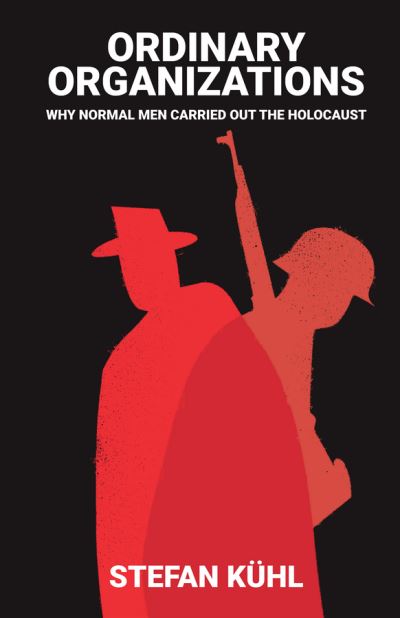
During the Holocaust, 99 percent of all Jewish killings were carried out by members of state organizations. In this groundbreaking book, Stefan Kühl offers a new analysis of the integral role that membership in organizations played in facilitating the annihilation of European Jews under the Nazis.
Drawing on the well-researched case of the mass killings of Jews by a Hamburg reserve police battalion, Kühl shows how ordinary men from ordinary professions were induced to carry out massacres. It may have been that coercion, money, identification with the end goal, the enjoyment of brutality, or the expectations of their comrades impelled the members of the police battalion to join the police units and participate in ghetto liquidations, deportations, and mass shootings. But ultimately, argues Kühl, the question of immediate motives, or indeed whether members carried out tasks with enthusiasm or reluctance, is of secondary importance. The crucial factor in explaining what they did was the integration of individuals into an organizational framework that prompted them to perform their roles.
This book makes a major contribution to our understanding of the Holocaust by demonstrating the fundamental role played by organizations in persuading ordinary Germans to participate in the annihilation of the Jews. It will be an invaluable resource for students and scholars of organizations, violence, and modern German history, as well as for anyone interested in genocide and the Holocaust.
| ISBN: | 9781509502905 |
| Publication date: | 30th September 2016 |
| Author: | Stefan Kühl |
| Publisher: | Polity Press |
| Format: | Paperback |
| Pagination: | 300 pages |
| Genres: |
History and Archaeology The Holocaust |
During the Holocaust, 99 percent of all Jewish killings were carried out by members of state organizations. In this groundbreaking book, Stefan Kühl offers a new analysis of the integral role that membership in organizations played in facilitating the annihilation of European Jews under the Nazis.
Drawing on the well-researched case of the mass killings of Jews by a Hamburg reserve police battalion, Kühl shows how ordinary men from ordinary professions were induced to carry out massacres. It may have been that coercion, money, identification with the end goal, the enjoyment of brutality, or the expectations of their comrades impelled the members of the police battalion to join the police units and participate in ghetto liquidations, deportations, and mass shootings. But ultimately, argues Kühl, the question of immediate motives, or indeed whether members carried out tasks with enthusiasm or reluctance, is of secondary importance. The crucial factor in explaining what they did was the integration of individuals into an organizational framework that prompted them to perform their roles.
This book makes a major contribution to our understanding of the Holocaust by demonstrating the fundamental role played by organizations in persuading ordinary Germans to participate in the annihilation of the Jews. It will be an invaluable resource for students and scholars of organizations, violence, and modern German history, as well as for anyone interested in genocide and the Holocaust.
Ordinary Organisations features in the following genres: History
Ordinary Organisations is available in Hardback, Paperback
Ordinary Organisations was written by Stefan Kühl and published by Polity Press
Ordinary Organisations has 300 pages
£16.19