

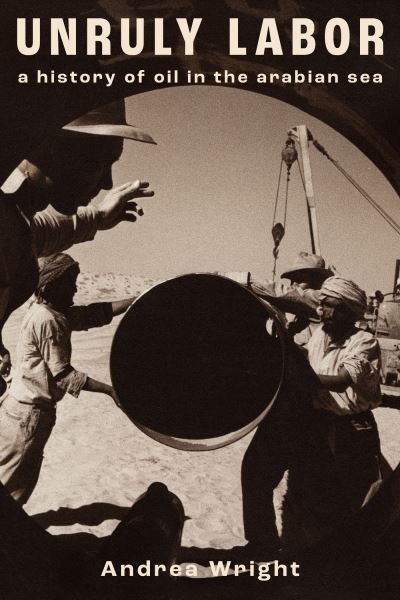
In the mid-twentieth century, the Arabian Peninsula emerged as a key site of oil production. International companies recruited workers from across the Middle East and Asia to staff their expanding oil projects. Unruly Labor considers the working conditions, hiring practices, and, most important, worker actions and strikes at these oil projects. It illuminates the multiple ways workers built transnational solidarities to agitate for better working conditions, and how worker actions informed shifting understandings of rights, citizenship, and national security.
Andrea Wright highlights the increasing associations between oil, governance, and racialized management practices to map how labor was increasingly depoliticized. From the 1940s to 1971, a period that includes the end of formal British imperialism in the Arabian Sea and the development of new state governments, citizenship became both an avenue for workers to advocate for their rights and, simultaneously, a way to limit other solidarities. Examining the interests of workers, government officials, and oil company managers alike, Wright offers a new history of Middle Eastern oil and twentieth-century capitalism-a history that illuminates how labor management and national security concerns have shaped state governance and economic policy priorities.
| ISBN: | 9781503639423 |
| Publication date: | 22nd October 2024 |
| Author: | Andrea Wright |
| Publisher: | Stanford University Press |
| Format: | Paperback |
| Pagination: | 312 pages |
| Series: | Stanford Studies in Middle Eastern and Islamic Societies and Cultures |
| Genres: |
Industrial relations, occupational health and safety General and world history Middle Eastern history |
In the mid-twentieth century, the Arabian Peninsula emerged as a key site of oil production. International companies recruited workers from across the Middle East and Asia to staff their expanding oil projects.
Unruly Labor features in the following genres: Industrial relations, occupational health and safety, General and world history, Middle Eastern history
Hardback, Paperback. £19.79, down from the £21.99 cover price. Not Available.
Unruly Labor was written by Andrea Wright and published by Stanford University Press
Unruly Labor has 312 pages
Yes it is part of Stanford Studies in Middle Eastern and Islamic Societies and Cultures series
£19.79, reduced from £21.99. Not Available.