

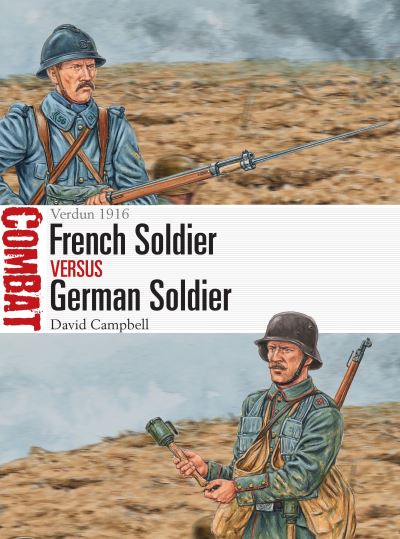
On 21 February 1916, the German Army launched a major attack on the French fortress of Verdun.
The Germans were confident that the ensuing battle would compel France to expend its strategic reserves in a savage attritional battle, thereby wearing down Allied fighting power on the Western Front. However, initial German success in capturing a key early objective, Fort Douaumont, was swiftly stemmed by the French defences, despite heavy French casualties. The Germans then switched objectives, but made slow progress towards their goals; by July, the battle had become a stalemate.
During the protracted struggle for Verdun, the two sides' infantrymen faced appalling battlefield conditions; their training, equipment and doctrine would be tested to the limit and beyond. New technologies, including flamethrowers, hand grenades, trench mortars and more mobile machine guns, would play a key role in the hands of infantry specialists thrown into the developing battle, and innovations in combat communications were employed to overcome the confusion of the battlefield.
This study outlines the two sides' wider approach to the evolving battle, before assessing the preparations and combat record of the French and German fighting men who fought one another during three pivotal moments of the 10½-month struggle for Verdun.
| ISBN: | 9781472838179 |
| Publication date: | 19th March 2020 |
| Author: | D Campbell |
| Illustrator: | Adam Hook |
| Publisher: | Osprey Publishing an imprint of Bloomsbury Publishing (UK) |
| Format: | Paperback |
| Pagination: | 80 pages |
| Series: | Combat |
| Genres: |
First World War Land forces and warfare Military and defence strategy |
On 21 February 1916, the German Army launched a major attack on the French fortress of Verdun.
The Germans were confident that the ensuing battle would compel France to expend its strategic reserves in a savage attritional battle, thereby wearing down Allied fighting power on the Western Front. However, initial German success in capturing a key early objective, Fort Douaumont, was swiftly stemmed by the French defences, despite heavy French casualties. The Germans then switched objectives, but made slow progress towards their goals; by July, the battle had become a stalemate.
During the protracted struggle for Verdun, the two sides' infantrymen faced appalling battlefield conditions; their training, equipment and doctrine would be tested to the limit and beyond. New technologies, including flamethrowers, hand grenades, trench mortars and more mobile machine guns, would play a key role in the hands of infantry specialists thrown into the developing battle, and innovations in combat communications were employed to overcome the confusion of the battlefield.
This study outlines the two sides' wider approach to the evolving battle, before assessing the preparations and combat record of the French and German fighting men who fought one another during three pivotal moments of the 10½-month struggle for Verdun.
French Soldier Vs German Soldier features in the following genres: First World War, Land forces and warfare, Military and defence strategy
French Soldier Vs German Soldier is available in Paperback
French Soldier Vs German Soldier was written by D Campbell and published by Osprey Publishing an imprint of Bloomsbury Publishing (UK)
French Soldier Vs German Soldier has 80 pages
Yes it is part of Combat series
£12.59