

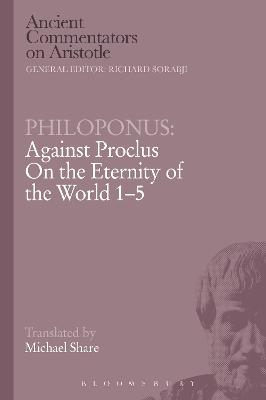
This is a post-Aristotelian Greek philosophical text, written at a crucial moment in the defeat of paganism by Christianity, AD 529, when the Emperor Justinian closed the pagan Neoplatonist school in Athens. Philoponus in Alexandria was a brilliant Christian philosopher, steeped in Neoplatanism, who turned the pagans' ideas against them. Here he attacks the most devout of the earlier Athenian pagan philosophers, Proclus, defending the distinctively Christian view that the universe had a beginning against Proclus' eighteen arguments to the contrary, which are discussed in eighteen chapters. Chapters 1-5 are translated in this volume.
| ISBN: | 9781472557445 |
| Publication date: | 10th April 2014 |
| Author: | Philoponus |
| Publisher: | Bloomsbury Academic an imprint of Bloomsbury Publishing PLC |
| Format: | Paperback |
| Pagination: | 192 pages |
| Series: | Ancient Commentators on Aristotle |
| Genres: |
Ancient Greek and Roman philosophy |
This is a post-Aristotelian Greek philosophical text, written at a crucial moment in the defeat of paganism by Christianity, AD 529, when the Emperor Justinian closed the pagan Neoplatonist school in Athens. Philoponus in Alexandria was a brilliant Christian philosopher, steeped in Neoplatanism, who turned the pagans' ideas against them. Here he attacks the most devout of the earlier Athenian pagan philosophers, Proclus, defending the distinctively Christian view that the universe had a beginning against Proclus' eighteen arguments to the contrary, which are discussed in eighteen chapters. Chapters 1-5 are translated in this volume.
Philoponus: Against Proclus On the Eternity of the World 1-5 features in the following genres: Ancient Greek and Roman philosophy
Philoponus: Against Proclus On the Eternity of the World 1-5 is available in Paperback
Philoponus: Against Proclus On the Eternity of the World 1-5 was written by Philoponus and published by Bloomsbury Academic an imprint of Bloomsbury Publishing PLC
Philoponus: Against Proclus On the Eternity of the World 1-5 has 192 pages
Yes it is part of Ancient Commentators on Aristotle series