

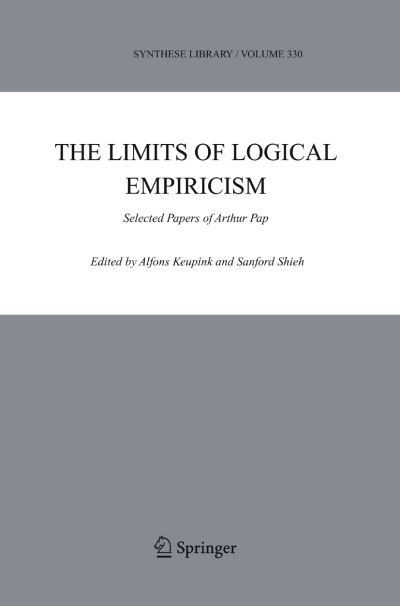
Arthur Pap's work played an important role in the development of the analytic tradition. This role goes beyond the merely historical fact that Pap's views of dispositional and modal concepts were influential. As a sympathetic critic of logical empiricism, Pap, like Quine, saw a deep tension in logical empiricism at its very best in the work of Carnap. But Pap's critique of Carnap is quite different from Quine's, and represents the discovery of limits beyond which empiricism cannot go, where there lies nothing other than intuitive knowledge of logic itself. Pap's arguments for this intuitive knowledge anticipate Etchemendy's recent critique of the model-theoretic account of logical consequence. Pap's work also anticipates prominent developments in the contemporary neo-Fregean philosophy of mathematics championed by Wright and Hale. Finally, Pap's major philosophical preoccupation, the concepts of necessity and possibility, provides distinctive solutions and perspectives on issues of contemporary concern in the metaphysics of modality. In particular, Pap's account of modality allows us to see the significance of Kripke's well-known arguments on necessity and apriority in a new light.
| ISBN: | 9781402042980 |
| Publication date: | 2nd March 2006 |
| Author: | Arthur Pap, Alfons Keupink, Sanford Shieh |
| Publisher: | Springer an imprint of Springer Netherlands |
| Format: | Hardback |
| Pagination: | 394 pages |
| Series: | Synthese Library |
| Genres: |
Philosophy: metaphysics and ontology Philosophy: logic Philosophy of language Philosophy of science Philosophy |
Arthur Pap's work played an important role in the development of the analytic tradition. This role goes beyond the merely historical fact that Pap's views of dispositional and modal concepts were influential. As a sympathetic critic of logical empiricism, Pap, like Quine, saw a deep tension in logical empiricism at its very best in the work of Carnap. But Pap's critique of Carnap is quite different from Quine's, and represents the discovery of limits beyond which empiricism cannot go, where there lies nothing other than intuitive knowledge of logic itself. Pap's arguments for this intuitive knowledge anticipate Etchemendy's recent critique of the model-theoretic account of logical consequence. Pap's work also anticipates prominent developments in the contemporary neo-Fregean philosophy of mathematics championed by Wright and Hale. Finally, Pap's major philosophical preoccupation, the concepts of necessity and possibility, provides distinctive solutions and perspectives on issues of contemporary concern in the metaphysics of modality. In particular, Pap's account of modality allows us to see the significance of Kripke's well-known arguments on necessity and apriority in a new light.
The Limits of Logical Empiricism features in the following genres: Philosophy: metaphysics and ontology, Philosophy: logic, Philosophy of language, Philosophy of science, Philosophy
The Limits of Logical Empiricism is available in Hardback
The Limits of Logical Empiricism was written by Arthur Pap, Alfons Keupink, Sanford Shieh and published by Springer an imprint of Springer Netherlands
The Limits of Logical Empiricism has 394 pages
Yes it is part of Synthese Library series