

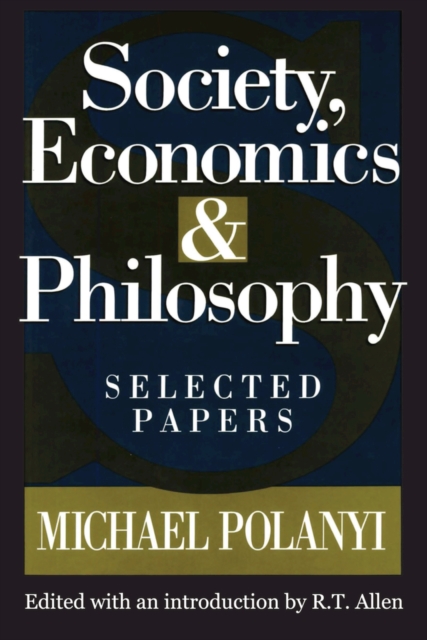
Society, Economics and Philosophy represents the full range of Polanyi's interests outside of his scientific work: economics, politics, society, philosophy of science, religion and positivist obstacles to it, and art. Polanyi's principal ideas are contained in three essays: on the scientific revolution, the creative imagination and the mind-body relation. Precisely because of Polanyi's work in the physical sciences, his writings have a unique dimension not found in other advocates of the market and too infrequently found even in philosophers of science.Polanyi was a powerful critic of totalitarianism and of the deficiencies of the usual defenses of freedom which helped to prepare the way for it. Freedom, he argued, can be based only upon truth and dedication to transcendent ideals, not upon skepticism, utilitarianism and the liberty of doing merely as one pleases. At a time when easy slogans about socialism were dominant in intellectual circles, epitomized by Sidney and Beatrice Webb, and when calls for the central planning of scientific research were made by such as J.D. Bernal, Polanyi exposed their errors and showed that science can flourish only in a free society.More radically than even von Mises and Hayek, Polanyi showed that an industrial economy can operate only polycentrically, that central planning is logically impossible, and that what was called by that name in the Soviet Union was in reality no such thing. Likewise, scientific research can proceed, not by a central plan, but only by the spontaneous self-adjustment of separate initiatives to discover a common reality. Against the positivism dominant within philosophy of science, he argued that the notion of reality must be restored and made central. Yet physical sciences, he also argued, are only one branch of science, and the sciences of life and mind are logically richer and more complex and cannot be reduced to the former, nor mind to body or to computers, nor art to its ph
| ISBN: | 9781351489096 |
| Publication date: | 28th July 2017 |
| Author: | Polanyi, Michael |
| Publisher: | Taylor and Francis |
| Format: | Ebook |
Society, Economics and Philosophy represents the full range of Polanyi's interests outside of his scientific work: economics, politics, society, philosophy of science, religion and positivist obstacles to it, and art. Polanyi's principal ideas are contained in three essays: on the scientific revolution, the creative imagination and the mind-body relation. Precisely because of Polanyi's work in the physical sciences, his writings have a unique dimension not found in other advocates of the market and too infrequently found even in philosophers of science.Polanyi was a powerful critic of totalitarianism and of the deficiencies of the usual defenses of freedom which helped to prepare the way for it. Freedom, he argued, can be based only upon truth and dedication to transcendent ideals, not upon skepticism, utilitarianism and the liberty of doing merely as one pleases. At a time when easy slogans about socialism were dominant in intellectual circles, epitomized by Sidney and Beatrice Webb, and when calls for the central planning of scientific research were made by such as J.D. Bernal, Polanyi exposed their errors and showed that science can flourish only in a free society.More radically than even von Mises and Hayek, Polanyi showed that an industrial economy can operate only polycentrically, that central planning is logically impossible, and that what was called by that name in the Soviet Union was in reality no such thing. Likewise, scientific research can proceed, not by a central plan, but only by the spontaneous self-adjustment of separate initiatives to discover a common reality. Against the positivism dominant within philosophy of science, he argued that the notion of reality must be restored and made central. Yet physical sciences, he also argued, are only one branch of science, and the sciences of life and mind are logically richer and more complex and cannot be reduced to the former, nor mind to body or to computers, nor art to its ph
Society, Economics, and Philosophy is available in Ebook, Paperback
Society, Economics, and Philosophy was written by Polanyi, Michael and published by Taylor and Francis
£46.99