

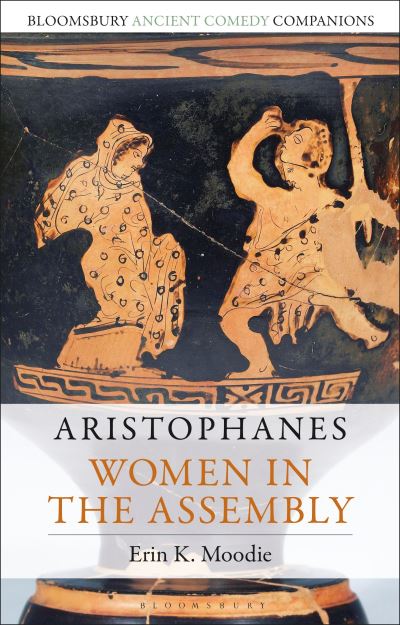
This is the first book for a general audience about Women in the Assembly (Ekklesiazousai), whose central themes - gender, politics, theatre - still resonate today.
Fed up with Athens' political dysfunction and involvement in yet another war against Sparta, the women of the city don ridiculous disguises and vote themselves into power. Under female leadership Athenian society is completely reorganized when both private property and marriage are abolished. What happens when a few citizens are slow to embrace the changes? Whose side was the audience on? The Athens that these women create has been interpreted in both utopian and near-dystopian terms, but Moodie argues that Aristophanes does indeed depict a utopia where everyone's needs can be met.
With new analysis of pottery and figurines depicting Old Comedy, coupled with a thorough exploration of Aristophanes' metatheatrical plot and its relation to his earlier fantastic comedies, Moodie reveals how the comic poet promotes the ideas of his female reformers and blunts the complaints of their critics as he urges collective action for the good of the city. Moodie concludes with a chapter exploring the ways in which playwrights and directors throughout the twentieth and twenty-first centuries have adapted Women in the Assembly in order to respond to current social and political issues, especially the changing role of women in the modern world.
| ISBN: | 9781350378209 |
| Publication date: | 11th June 2026 |
| Author: | Erin K Moodie |
| Publisher: | Bloomsbury Academic an imprint of Bloomsbury Publishing (UK) |
| Format: | Hardback |
| Pagination: | 200 pages |
| Series: | Bloomsbury Ancient Comedy Companions |
| Genres: |
Ancient, classical and medieval texts Comedic plays Literary studies: plays and playwrights |
This is the first book for a general audience about Women in the Assembly (Ekklesiazousai), whose central themes - gender, politics, theatre - still resonate today.
Fed up with Athens' political dysfunction and involvement in yet another war against Sparta, the women of the city don ridiculous disguises and vote themselves into power. Under female leadership Athenian society is completely reorganized when both private property and marriage are abolished. What happens when a few citizens are slow to embrace the changes? Whose side was the audience on? The Athens that these women create has been interpreted in both utopian and near-dystopian terms, but Moodie argues that Aristophanes does indeed depict a utopia where everyone's needs can be met.
With new analysis of pottery and figurines depicting Old Comedy, coupled with a thorough exploration of Aristophanes' metatheatrical plot and its relation to his earlier fantastic comedies, Moodie reveals how the comic poet promotes the ideas of his female reformers and blunts the complaints of their critics as he urges collective action for the good of the city. Moodie concludes with a chapter exploring the ways in which playwrights and directors throughout the twentieth and twenty-first centuries have adapted Women in the Assembly in order to respond to current social and political issues, especially the changing role of women in the modern world.
Aristophanes features in the following genres: Ancient, classical and medieval texts, Comedic plays, Literary studies: plays and playwrights
Aristophanes is available in Hardback
Aristophanes was written by Erin K Moodie and published by Bloomsbury Academic an imprint of Bloomsbury Publishing (UK)
Aristophanes has 200 pages
Yes it is part of Bloomsbury Ancient Comedy Companions series
£63.00