

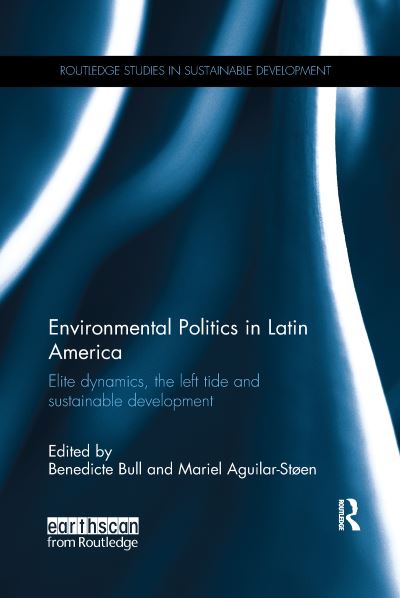
Since colonial times the position of the social, political and economic elites in Latin America has been intimately connected to their control over natural resources. Consequently, struggles to protect the environment from over-exploitation and contamination have been related to marginalized groups' struggles against local, national and transnational elites. The recent rise of progressive, left-leaning governments - often supported by groups struggling for environmental justice - has challenged the established elites and raised expectations about new regimes for natural resource management.
Based on case-studies in eight Latin American countries (Argentina, Brazil, Chile, Ecuador, Colombia, Bolivia, El Salvador and Guatemala), this book investigates the extent to which there have been elite shifts, how new governments have related to old elites, and how that has impacted on environmental governance and the management of natural resources. It examines the rise of new cadres of technocrats and the old economic and political elites' struggle to remain influential. The book also discusses the challenges faced in trying to overcome structural inequalities to ensure a more sustainable and equitable governance of natural resources.
This timely book will be of great interest to researchers and masters students in development studies, environmental management and governance, geography, political science and Latin American area studies.
| ISBN: | 9781138212459 |
| Publication date: | 26th August 2016 |
| Author: | Benedicte Bull, Mariel AguilarStøen |
| Publisher: | Routledge an imprint of Taylor & Francis |
| Format: | Paperback |
| Pagination: | 220 pages |
| Series: | Routledge Studies in Sustainable Development |
| Genres: |
Environmental policy and protocols Climate change Ethnic studies Regional / International studies Development studies Environmental management Human geography Regional geography Politics and government |
Since colonial times the position of the social, political and economic elites in Latin America has been intimately connected to their control over natural resources. Consequently, struggles to protect the environment from over-exploitation and contamination have been related to marginalized groups' struggles against local, national and transnational elites. The recent rise of progressive, left-leaning governments - often supported by groups struggling for environmental justice - has challenged the established elites and raised expectations about new regimes for natural resource management.
Based on case-studies in eight Latin American countries (Argentina, Brazil, Chile, Ecuador, Colombia, Bolivia, El Salvador and Guatemala), this book investigates the extent to which there have been elite shifts, how new governments have related to old elites, and how that has impacted on environmental governance and the management of natural resources. It examines the rise of new cadres of technocrats and the old economic and political elites' struggle to remain influential. The book also discusses the challenges faced in trying to overcome structural inequalities to ensure a more sustainable and equitable governance of natural resources.
This timely book will be of great interest to researchers and masters students in development studies, environmental management and governance, geography, political science and Latin American area studies.
Environmental Politics in Latin America features in the following genres: Environmental policy and protocols, Climate change, Ethnic studies, Regional / International studies, Development studies, Environmental management, Human geography, Regional geography, Politics and government
Environmental Politics in Latin America is available in Paperback
Environmental Politics in Latin America was written by Benedicte Bull, Mariel AguilarStøen and published by Routledge an imprint of Taylor & Francis
Environmental Politics in Latin America has 220 pages
Yes it is part of Routledge Studies in Sustainable Development series
£50.39