

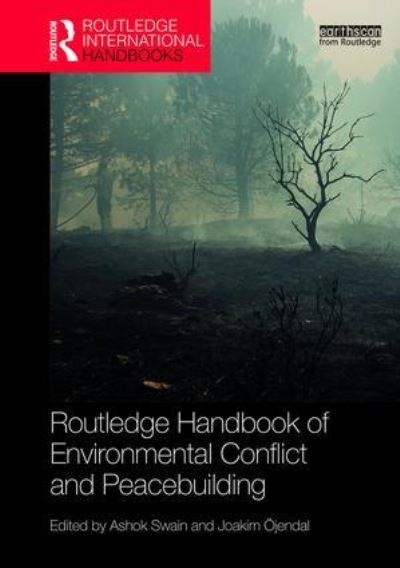
The past two decades have witnessed the emergence of a large body of research examining the linkage between environmental scarcity, violent conflict, and cooperation. However, this environmental security polemic is still trying to deliver a well-defined approach to achieving peace. Studies are being undertaken to find the precise pathways by which cooperative actions are expected not only to pre-empt or moderate resource conflicts but also to help diffuse cooperative behaviour to other disputed issues. The recognition that environmental resources can contribute to violent conflict accentuates their potential significance as pathways for cooperation and the consolidation of peace in post-conflict societies.
Conceived as a single and reliable reference source which will be a vital resource for students, researchers, and policy makers alike, the Routledge Handbook of Environmental Conflict and Peacebuilding presents a wide range of chapters written by key thinkers in the field, organised into four key parts:
Enabling the reader to find a concise expert review on topics that are most likely to arise in the course of conducting research or policy making, this volume presents a truly global overview of the key issues and debates in environmental conflict and peacebuilding.
| ISBN: | 9781138202528 |
| Publication date: | 17th April 2018 |
| Author: | Ashok Swain, Joakim Öjendal |
| Publisher: | Routledge an imprint of Taylor & Francis |
| Format: | Hardback |
| Pagination: | 340 pages |
| Series: | Routledge International Handbooks |
| Genres: |
Warfare and defence Climate change Environmental policy and protocols Development studies Peace studies and conflict resolution Politics and government |
The past two decades have witnessed the emergence of a large body of research examining the linkage between environmental scarcity, violent conflict, and cooperation. However, this environmental security polemic is still trying to deliver a well-defined approach to achieving peace. Studies are being undertaken to find the precise pathways by which cooperative actions are expected not only to pre-empt or moderate resource conflicts but also to help diffuse cooperative behaviour to other disputed issues. The recognition that environmental resources can contribute to violent conflict accentuates their potential significance as pathways for cooperation and the consolidation of peace in post-conflict societies.
Conceived as a single and reliable reference source which will be a vital resource for students, researchers, and policy makers alike, the Routledge Handbook of Environmental Conflict and Peacebuilding presents a wide range of chapters written by key thinkers in the field, organised into four key parts:
Enabling the reader to find a concise expert review on topics that are most likely to arise in the course of conducting research or policy making, this volume presents a truly global overview of the key issues and debates in environmental conflict and peacebuilding.
Routledge Handbook of Environmental Conflict and Peacebuilding features in the following genres: Warfare and defence, Climate change, Environmental policy and protocols, Development studies, Peace studies and conflict resolution, Politics and government
Routledge Handbook of Environmental Conflict and Peacebuilding is available in Hardback
Routledge Handbook of Environmental Conflict and Peacebuilding was written by Ashok Swain, Joakim Öjendal and published by Routledge an imprint of Taylor & Francis
Routledge Handbook of Environmental Conflict and Peacebuilding has 340 pages
Yes it is part of Routledge International Handbooks series
£234.00