

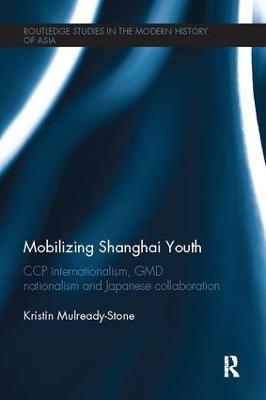
In the late nineteenth and early twentieth centuries, youth emerged as a new and important social force in many parts of the world. In China the image of this new youth imprinted itself on Chinese consciousness and made clear to potential national leaders that future governments would not be able to ignore China’s youth or expect them simply to step in line. For this and other reasons, the Chinese Communist Party (CCP), the Chinese Nationalist Party (GMD) and a string of War of Resistance-era collaborationist governments all formed youth organizations in an effort to win youth over and harness their vitality and enthusiasm to further their agendas. Mobilizing Shanghai Youth explores the similarities and differences among three youth organizations that were connected to Chinese political parties or governments in Shanghai, spanning from the beginning of the May Fourth Movement, just as youth began to emerge as a powerful social and political force in China, to World War II, when Nationalist, Communist and Japanese forces were still competing for dominance. It takes a comparative approach in exploring the similarities and differences, trials and tribulations in how the Chinese Communist Party, Chinese Nationalist Party and a series of collaborationist regimes sought to appeal to youth through the Communist Youth League, the Three People’s Principles Youth Corps and the China Youth Corps. Focusing on Greater Shanghai allows a detailed exploration of the rise and fall of the original Communist Youth League and its connections to international communism. The spotlight on Shanghai also yields the extraordinary finding that the Three People’s Principles Youth Corps was a valuable asset to the Nationalist Party, operating as a potent resistance organization in Japanese-controlled Shanghai whereas branches in Nationalist-controlled territory were factionalized, dysfunctional and a terrible liability for the Party. Most surprisingly, the collaborationist China Youth Corps took the most practical and in some ways the most successful approach to mobilizing China’s youth. The result of exhaustive archival research, this book will be of huge interest to students and scholars of Chinese history, modern history, Communism and the role of youth in revolution.
| ISBN: | 9781138095076 |
| Publication date: | 25th May 2017 |
| Author: | Kristin Kansas State University, USA MulreadyStone |
| Publisher: | Routledge an imprint of Taylor & Francis Ltd |
| Format: | Paperback |
| Pagination: | 208 pages |
| Series: | Routledge Studies in the Modern History of Asia |
| Genres: |
Regional / International studies History and Archaeology Social and political philosophy Far-left political ideologies and movements Asian history |
In the late nineteenth and early twentieth centuries, youth emerged as a new and important social force in many parts of the world. In China the image of this new youth imprinted itself on Chinese consciousness and made clear to potential national leaders that future governments would not be able to ignore China’s youth or expect them simply to step in line. For this and other reasons, the Chinese Communist Party (CCP), the Chinese Nationalist Party (GMD) and a string of War of Resistance-era collaborationist governments all formed youth organizations in an effort to win youth over and harness their vitality and enthusiasm to further their agendas. Mobilizing Shanghai Youth explores the similarities and differences among three youth organizations that were connected to Chinese political parties or governments in Shanghai, spanning from the beginning of the May Fourth Movement, just as youth began to emerge as a powerful social and political force in China, to World War II, when Nationalist, Communist and Japanese forces were still competing for dominance. It takes a comparative approach in exploring the similarities and differences, trials and tribulations in how the Chinese Communist Party, Chinese Nationalist Party and a series of collaborationist regimes sought to appeal to youth through the Communist Youth League, the Three People’s Principles Youth Corps and the China Youth Corps. Focusing on Greater Shanghai allows a detailed exploration of the rise and fall of the original Communist Youth League and its connections to international communism. The spotlight on Shanghai also yields the extraordinary finding that the Three People’s Principles Youth Corps was a valuable asset to the Nationalist Party, operating as a potent resistance organization in Japanese-controlled Shanghai whereas branches in Nationalist-controlled territory were factionalized, dysfunctional and a terrible liability for the Party. Most surprisingly, the collaborationist China Youth Corps took the most practical and in some ways the most successful approach to mobilizing China’s youth. The result of exhaustive archival research, this book will be of huge interest to students and scholars of Chinese history, modern history, Communism and the role of youth in revolution.
Mobilizing Shanghai Youth features in the following genres: Regional / International studies, History and Archaeology, Social and political philosophy, Far-left political ideologies and movements, Asian history
Mobilizing Shanghai Youth is available in Paperback, Hardback
Mobilizing Shanghai Youth was written by Kristin Kansas State University, USA MulreadyStone and published by Routledge an imprint of Taylor & Francis Ltd
Mobilizing Shanghai Youth has 208 pages
Yes it is part of Routledge Studies in the Modern History of Asia series
£50.39