

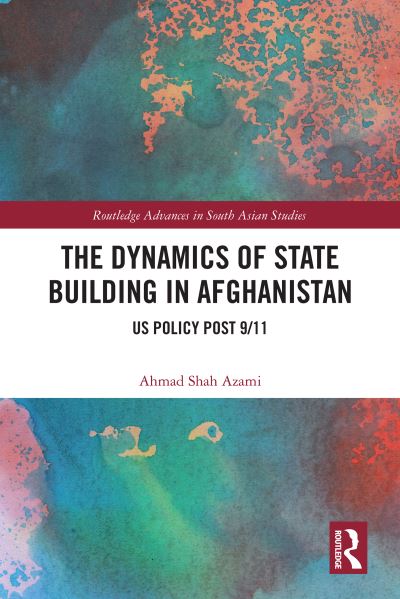
This book offers an all-encompassing, critical analysis of U.S.-led state-building in Afghanistan between 2001 and 2021, focusing on the three central pillars of security and peacebuilding, democratization, and economic development and reconstruction.
The book demonstrates how Afghans navigated the promises of an international project that aspired to rebuild sustainable and successful state institutions, but which often provoked fractures and neglected legitimate local agency. Chapters highlight persistent shortcomings in Washington's strategy, including miscalculations and policy failures that undermined local governance and long-term stability. Drawing on extensive fieldwork and interviews, chapters provide original empirical insights by foregrounding Afghan voices-perspectives often marginalized in existing scholarship. Comprehensive in approach, the book ultimately offers a conceptual contribution to the study of intervention and state building, situating Afghanistan within broader debates on war and foreign intervention, peace and stability, and state building and governance.
Revealing the inherent limitations of externally driven state-building in fragile and conflict contexts, this book will be of interest to researchers studying international relations, political science, South Asian and Middle East studies, and the U.S. War on Terror.
| ISBN: | 9781041138686 |
| Publication date: | 11th June 2026 |
| Author: | Ahmad Shah Azami |
| Publisher: | Routledge an imprint of Taylor & Francis |
| Format: | Hardback |
| Pagination: | 224 pages |
| Series: | Routledge Advances in South Asian Studies |
| Genres: |
Regional / International studies Development studies Peace studies and conflict resolution International relations Theory of warfare and military science |
This book offers an all-encompassing, critical analysis of U.S.-led state-building in Afghanistan between 2001 and 2021, focusing on the three central pillars of security and peacebuilding, democratization, and economic development and reconstruction.
The book demonstrates how Afghans navigated the promises of an international project that aspired to rebuild sustainable and successful state institutions, but which often provoked fractures and neglected legitimate local agency. Chapters highlight persistent shortcomings in Washington's strategy, including miscalculations and policy failures that undermined local governance and long-term stability. Drawing on extensive fieldwork and interviews, chapters provide original empirical insights by foregrounding Afghan voices-perspectives often marginalized in existing scholarship. Comprehensive in approach, the book ultimately offers a conceptual contribution to the study of intervention and state building, situating Afghanistan within broader debates on war and foreign intervention, peace and stability, and state building and governance.
Revealing the inherent limitations of externally driven state-building in fragile and conflict contexts, this book will be of interest to researchers studying international relations, political science, South Asian and Middle East studies, and the U.S. War on Terror.
The Dynamics of State Building in Afghanistan features in the following genres: Regional / International studies, Development studies, Peace studies and conflict resolution, International relations, Theory of warfare and military science
The Dynamics of State Building in Afghanistan is available in Hardback
The Dynamics of State Building in Afghanistan was written by Ahmad Shah Azami and published by Routledge an imprint of Taylor & Francis
The Dynamics of State Building in Afghanistan has 224 pages
Yes it is part of Routledge Advances in South Asian Studies series
£154.79