

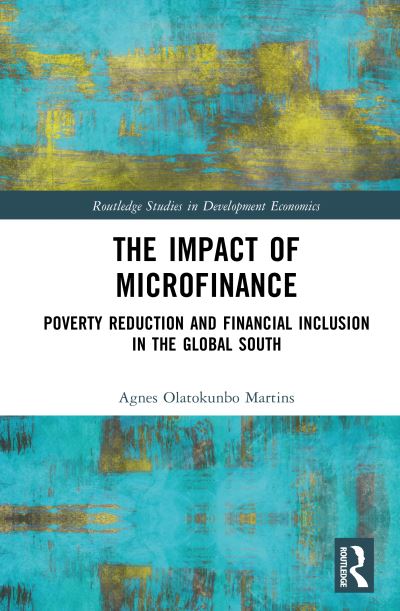
Historically, microfinance has emerged as a means to extend financial services to previously excluded populations, serving as a pathway to poverty reduction and aligning with Sustainable Development Goal 1: End poverty in all its forms everywhere. This book argues that microfinance plays a crucial role in achieving financial inclusion, significantly enhancing economic welfare, and reducing poverty in developing countries.
It highlights the necessity to rigorously address issues such as mission drift, macroeconomic stability, governance, regulatory frameworks, and enforcement. It provides a contemporary and comprehensive overview of microfinance implementation in developing countries, enabling comparative analysis of regulatory and supervisory practices, and evaluates theoretical frameworks linking microfinance to economic growth and poverty reduction, utilising concepts of financial intermediation, resource allocation, and financial development. The book empirically tests the causal relationships between microfinance, economic growth, and poverty reduction using a balanced panel dataset of macroeconomic and microeconomic indicators and identifies and analyses the mechanisms through which microfinance impacts economic welfare and poverty reduction. As well as asking whether microfinance can alleviate multidimensional poverty in favourable macroeconomic, political, and business environments in developing countries, it also questions whether it enhances living standards, health, and education. It examines how economic shocks impact vulnerable populations and microfinance institutions and looks at the factors that contribute to the success of microfinance in countries where it is well-established. Further, it offers policy implications and recommendations to enhance the effectiveness of microfinance and address key challenges.
This book targets a broad spectrum of readers involved in microfinance, financial inclusion, and development economics, including researchers, academics and students as well as policymakers and government officials.
| ISBN: | 9781041128298 |
| Publication date: | 6th November 2025 |
| Author: | Agnes Olatokunbo Martins |
| Publisher: | Routledge an imprint of Taylor & Francis |
| Format: | Hardback |
| Pagination: | 192 pages |
| Series: | Routledge Studies in Development Economics |
| Genres: |
Development economics and emerging economies Banking |
Historically, microfinance has emerged as a means to extend financial services to previously excluded populations, serving as a pathway to poverty reduction and aligning with Sustainable Development Goal 1: End poverty in all its forms everywhere. This book argues that microfinance plays a crucial role in achieving financial inclusion, significantly enhancing economic welfare, and reducing poverty in developing countries.
It highlights the necessity to rigorously address issues such as mission drift, macroeconomic stability, governance, regulatory frameworks, and enforcement. It provides a contemporary and comprehensive overview of microfinance implementation in developing countries, enabling comparative analysis of regulatory and supervisory practices, and evaluates theoretical frameworks linking microfinance to economic growth and poverty reduction, utilising concepts of financial intermediation, resource allocation, and financial development. The book empirically tests the causal relationships between microfinance, economic growth, and poverty reduction using a balanced panel dataset of macroeconomic and microeconomic indicators and identifies and analyses the mechanisms through which microfinance impacts economic welfare and poverty reduction. As well as asking whether microfinance can alleviate multidimensional poverty in favourable macroeconomic, political, and business environments in developing countries, it also questions whether it enhances living standards, health, and education. It examines how economic shocks impact vulnerable populations and microfinance institutions and looks at the factors that contribute to the success of microfinance in countries where it is well-established. Further, it offers policy implications and recommendations to enhance the effectiveness of microfinance and address key challenges.
This book targets a broad spectrum of readers involved in microfinance, financial inclusion, and development economics, including researchers, academics and students as well as policymakers and government officials.
The Impact of Microfinance features in the following genres: Development economics and emerging economies, Political economy, Development studies, Macroeconomics, Hospitality and service industries, Finance and accounting
The Impact of Microfinance is available in Hardback
The Impact of Microfinance was written by Agnes Olatokunbo Martins and published by Routledge an imprint of Taylor & Francis
The Impact of Microfinance has 192 pages
Yes it is part of Routledge Studies in Development Economics series
£154.79