

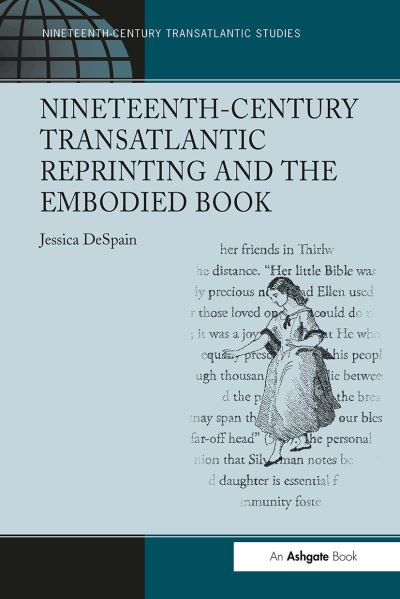
Until the Chace Act in 1891, no international copyright law existed between Britain and the United States, which meant publishers were free to edit text, excerpt whole passages, add new illustrations, and substantially redesign a book's appearance. In spite of this ongoing process of transatlantic transformation of texts, the metaphor of the book as a physical embodiment of its author persisted. Jessica DeSpain's study of this period of textual instability examines how the physical book acted as a major form of cultural exchange between Britain and the United States that called attention to volatile texts and the identities they manifested. Focusing on four influential works"Charles Dickens's American Notes for General Circulation, Susan Warner's The Wide, Wide World, Fanny Kemble's Journal of a Residence on a Georgian Plantation, and Walt Whitman's Democratic Vistas"DeSpain shows that for authors, readers, and publishers struggling with the unpredictability of the textual body, the physical book and the physical body became interchangeable metaphors of flux. At the same time, discourses of destabilized bodies inflected issues essential to transatlantic culture, including class, gender, religion, and slavery, while the practice of reprinting challenged the concepts of individual identity, personal property, and national identity.
| ISBN: | 9781032926773 |
| Publication date: | 14th October 2024 |
| Author: | Jessica DeSpain |
| Publisher: | Routledge an imprint of Taylor & Francis |
| Format: | Paperback |
| Pagination: | 224 pages |
| Series: | Ashgate Series in Nineteenth-Century Transatlantic Studies |
| Genres: |
Regional / International studies Literary studies: c 1800 to c 1900 European history |
Until the Chace Act in 1891, no international copyright law existed between Britain and the United States, which meant publishers were free to edit text, excerpt whole passages, add new illustrations, and substantially redesign a book's appearance. In spite of this ongoing process of transatlantic transformation of texts, the metaphor of the book as a physical embodiment of its author persisted. Jessica DeSpain's study of this period of textual instability examines how the physical book acted as a major form of cultural exchange between Britain and the United States that called attention to volatile texts and the identities they manifested. Focusing on four influential works"Charles Dickens's American Notes for General Circulation, Susan Warner's The Wide, Wide World, Fanny Kemble's Journal of a Residence on a Georgian Plantation, and Walt Whitman's Democratic Vistas"DeSpain shows that for authors, readers, and publishers struggling with the unpredictability of the textual body, the physical book and the physical body became interchangeable metaphors of flux. At the same time, discourses of destabilized bodies inflected issues essential to transatlantic culture, including class, gender, religion, and slavery, while the practice of reprinting challenged the concepts of individual identity, personal property, and national identity.
Nineteenth-Century Transatlantic Reprinting and the Embodied Book features in the following genres: Regional / International studies, Literary studies: c 1800 to c 1900, European history
Nineteenth-Century Transatlantic Reprinting and the Embodied Book is available in Paperback, Ebook, Hardback
Nineteenth-Century Transatlantic Reprinting and the Embodied Book was written by Jessica DeSpain and published by Routledge an imprint of Taylor & Francis
Nineteenth-Century Transatlantic Reprinting and the Embodied Book has 224 pages
Yes it is part of Ashgate Series in Nineteenth-Century Transatlantic Studies series
£38.69