

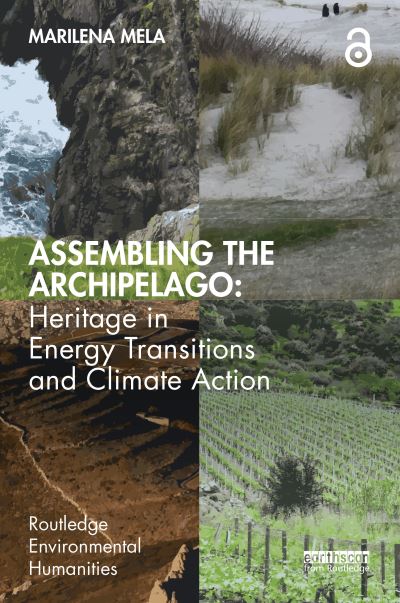
This book explores the potential of heritage to enact sustainable human-environment relationships across geographical differences. It does so by travelling to four archipelagoes: the Wadden Islands in the Netherlands, the Cyclades in Greece, Shetland in Scotland, and the Aeolian Islands in Italy.
In the face of planetary socioenvironmental crises, the reliance on sustainable development strategies, including the energy transition, on technocratic, top-down solutions fail to counterbalance global agendas of extraction and growth and address environmental injustices in "peripheral" places. This book stresses the need to "think small," arguing that seeds for meaningful change exist in such places and the geographically and historically situated relationships between people and environments. Islands, interconnected yet autonomous places with unique histories, are good places to start. In four archipelagoes, frictions produced both by climate change and climate mitigation ?the fragile consensus around a solar park in the Wadden Sea, conflicts around wind turbine towers in the Aegean, experiments with the tides in Shetland, and volcanic episodes in the Aeolian?come in dialogue with the learning potential of their environmental and cultural heritage. The counterposing of these stories renegotiates established discourses of heritage and sustainability and the associated courses of action in policy and planning.
This contribution will resonate with academics, students, policymakers, and activists in heritage studies, environmental humanities, landscape studies, science and technology studies, and sustainability. Readers are invited to participate in the life and troubles of four island landscapes, and to think along on emergent, archipelagic claims towards sustainable and just futures.
| ISBN: | 9781032854397 |
| Publication date: | 9th September 2025 |
| Author: | Marilena Mela |
| Publisher: | Routledge an imprint of Taylor & Francis |
| Format: | Hardback |
| Pagination: | 234 pages |
| Series: | Routledge Environmental Humanities |
| Genres: |
Cultural studies Climate change Urban and municipal planning and policy Alternative and renewable energy sources and technology Anthropology Landscape architecture and design Museology and heritage studies Human geography History Civil engineering, surveying and building |
This book explores the potential of heritage to enact sustainable human-environment relationships across geographical differences. It does so by travelling to four archipelagoes: the Wadden Islands in the Netherlands, the Cyclades in Greece, Shetland in Scotland, and the Aeolian Islands in Italy.
In the face of planetary socioenvironmental crises, the reliance on sustainable development strategies, including the energy transition, on technocratic, top-down solutions fail to counterbalance global agendas of extraction and growth and address environmental injustices in "peripheral" places. This book stresses the need to "think small," arguing that seeds for meaningful change exist in such places and the geographically and historically situated relationships between people and environments. Islands, interconnected yet autonomous places with unique histories, are good places to start. In four archipelagoes, frictions produced both by climate change and climate mitigation ?the fragile consensus around a solar park in the Wadden Sea, conflicts around wind turbine towers in the Aegean, experiments with the tides in Shetland, and volcanic episodes in the Aeolian?come in dialogue with the learning potential of their environmental and cultural heritage. The counterposing of these stories renegotiates established discourses of heritage and sustainability and the associated courses of action in policy and planning.
This contribution will resonate with academics, students, policymakers, and activists in heritage studies, environmental humanities, landscape studies, science and technology studies, and sustainability. Readers are invited to participate in the life and troubles of four island landscapes, and to think along on emergent, archipelagic claims towards sustainable and just futures.
Assembling the Archipelago features in the following genres: Cultural studies, Climate change, Urban and municipal planning and policy, Alternative and renewable energy sources and technology, Anthropology, Landscape architecture and design, Museology and heritage studies, Human geography, History, Civil engineering, surveying and building
Assembling the Archipelago is available in Hardback
Assembling the Archipelago was written by Marilena Mela and published by Routledge an imprint of Taylor & Francis
Assembling the Archipelago has 234 pages
Yes it is part of Routledge Environmental Humanities series
£154.79