

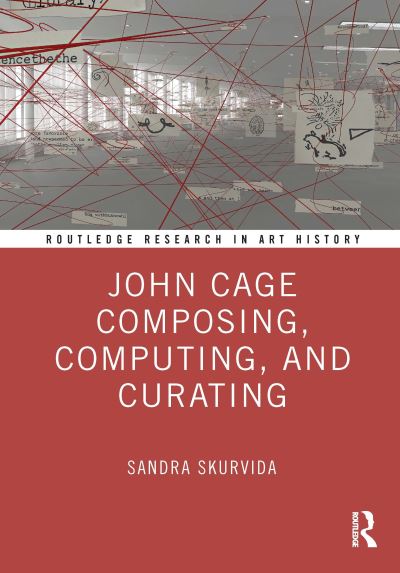
This study reassesses Cage's multifaceted practice from a transdisciplinary perspective, using text as a premise for his musical, visual, lingual, and museal compositions.
In his compositions, John Cage opened the structures of music, language, and the museum to change perpetuated by chance operations. His correspondences across history with an extended circle of creators, including Erik Satie, Marcel Duchamp, and Henry David Thoreau, among many others, erased single-minded authorship via methodical processing of source material.
Foreshadowing ecological recycling, Cage's late compositions for museum opened perspectives for posthuman mediation in curating and contemporary art. He conceived of anarchy as the coexistence of mutually aiding yet autonomous self-determinate entities. This book introduces Cage to the twenty-first century as a composer whose work intersects different temporalities and modes of being, the past and the present, the human and the non-human, and the individual and the communal.
The book will be of interest to scholars of art history, music, curatorial studies, and museum studies.
| ISBN: | 9781032717470 |
| Publication date: | 31st January 2025 |
| Author: | Sandra Skurvida |
| Publisher: | Routledge an imprint of Taylor & Francis |
| Format: | Hardback |
| Pagination: | 162 pages |
| Series: | Routledge Research in Art History |
| Genres: |
The arts: general topics Art music, orchestral and formal music Composers and songwriters Musicians, singers, bands and groups Museology and heritage studies History of art Theory of music and musicology |
This study reassesses Cage's multifaceted practice from a transdisciplinary perspective, using text as a premise for his musical, visual, lingual, and museal compositions.In his compositions, John Cage opened the structures of music, language, and the museum to change perpetuated by chance operations. His correspondences across history with an extended circle of creators, including Erik Satie, Marcel Duchamp, and Henry David Thoreau, among many others, erased single-minded authorship via methodical processing of source material.
John Cage Composing, Computing, and Curating features in the following genres: The arts: general topics, Art music, orchestral and formal music, Composers and songwriters, Musicians, singers, bands and groups, Museology and heritage studies, History of art, Theory of music and musicology
Paperback, Hardback. £154.79, down from the £171.99 cover price. Not Available.
John Cage Composing, Computing, and Curating was written by Sandra Skurvida and published by Routledge an imprint of Taylor & Francis
John Cage Composing, Computing, and Curating has 162 pages
Yes it is part of Routledge Research in Art History series
£154.79, reduced from £171.99. Not Available.