

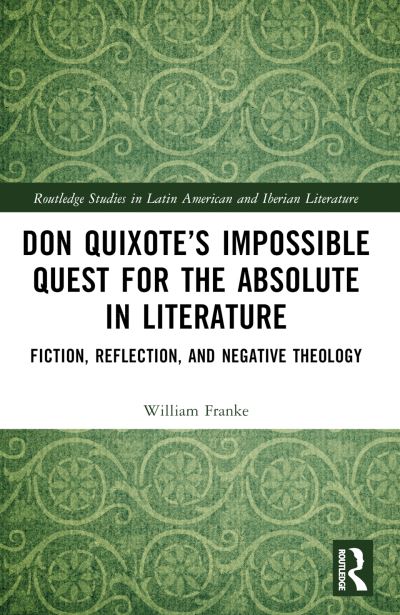
This book offers a reading particularly of Part II of Don Quixote, a reading that is embedded in a philosophical reflection on the revelation of religious truth in and through literature. Part II of Don Quixote is the far richer part for its meta-literary reflection on the novel itself as a genre and on life as such seen through the lens of self-reflection. The author has treated the phenomenon of modern self-reflexivity as originally theological in nature in previous publications (notably Dante's Paradiso and the Theological Origins of Modern Thought: Toward a Speculative Philosophy of Self-Reflection, Routledge, 2021). The present endeavor expands this overall intellectual project, extending it into detailed consideration of what is recognizably another nodal great work inaugurating unprecedented forms of self-reflection in the early modern period. Reading the founding texts of literary and cultural tradition in this negative-theological key proves crucial to allowing them to release the full force of their religious vision in the present age, despite its sometimes obstinate secularity.
This reading absorbs and reconciles the religious and secular readings of Miguel de Unamuno and José Ortega y Gasset, two of Spain's outstanding philosophical luminaries. Both thinkers based their entire philosophies and their analyses of the Spanish national character and destiny on their interpretations of the Quixote. Negative theology deploys critical reason that critiques the limits of reason itself and opens toward an unfathomable (un)ground of All. Such speculative interpretation performs a synthesis of the secularizing and sacralizing tendencies that are both sublimely operative in the text of the Quixote. It thereby enables the work to emerge in the fully parodic and paradoxical vitality that other interpretations, governed by one paradigm or the other, access only partially. Rather than falling into one camp or the other, the proposed approach combines and resources both heritages, sacred and secular, in their deepest synergisms. Spanish baroque mysticism and contemporary post-secular thought are made to converge in highlighting the blessed, even sacred, donation that literature like Don Quixote preserves and transmits as our most precious and saving cultural heritage.
| ISBN: | 9781032688992 |
| Publication date: | 30th January 2026 |
| Author: | William Franke |
| Publisher: | Routledge an imprint of Taylor & Francis |
| Format: | Paperback |
| Pagination: | 240 pages |
| Series: | Routledge Studies in Latin American and Iberian Literature |
| Genres: |
Literary studies: general |
This book offers a reading particularly of Part II of Don Quixote, a reading that is embedded in a philosophical reflection on the revelation of religious truth in and through literature. Part II of Don Quixote is the far richer part for its meta-literary reflection on the novel itself as a genre and on life as such seen through the lens of self-reflection. The author has treated the phenomenon of modern self-reflexivity as originally theological in nature in previous publications (notably Dante's Paradiso and the Theological Origins of Modern Thought: Toward a Speculative Philosophy of Self-Reflection, Routledge, 2021). The present endeavor expands this overall intellectual project, extending it into detailed consideration of what is recognizably another nodal great work inaugurating unprecedented forms of self-reflection in the early modern period. Reading the founding texts of literary and cultural tradition in this negative-theological key proves crucial to allowing them to release the full force of their religious vision in the present age, despite its sometimes obstinate secularity.
This reading absorbs and reconciles the religious and secular readings of Miguel de Unamuno and José Ortega y Gasset, two of Spain's outstanding philosophical luminaries. Both thinkers based their entire philosophies and their analyses of the Spanish national character and destiny on their interpretations of the Quixote. Negative theology deploys critical reason that critiques the limits of reason itself and opens toward an unfathomable (un)ground of All. Such speculative interpretation performs a synthesis of the secularizing and sacralizing tendencies that are both sublimely operative in the text of the Quixote. It thereby enables the work to emerge in the fully parodic and paradoxical vitality that other interpretations, governed by one paradigm or the other, access only partially. Rather than falling into one camp or the other, the proposed approach combines and resources both heritages, sacred and secular, in their deepest synergisms. Spanish baroque mysticism and contemporary post-secular thought are made to converge in highlighting the blessed, even sacred, donation that literature like Don Quixote preserves and transmits as our most precious and saving cultural heritage.
Don Quixote's Impossible Quest for the Absolute in Literature features in the following genres: Literary studies: general
Don Quixote's Impossible Quest for the Absolute in Literature is available in Paperback, Hardback
Don Quixote's Impossible Quest for the Absolute in Literature was written by William Franke and published by Routledge an imprint of Taylor & Francis
Don Quixote's Impossible Quest for the Absolute in Literature has 240 pages
Yes it is part of Routledge Studies in Latin American and Iberian Literature series
£40.49