

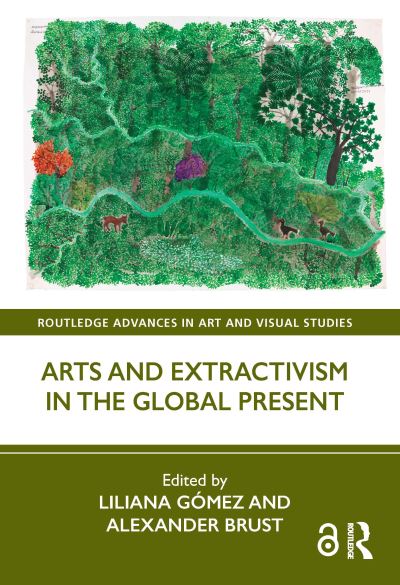
Through the lens of contemporary art, this book focuses on social ecologies and those spaces that are characterized, on the one hand, by a high degree of biodiversity and, on the other, by a long history of the extraction of resources, (neo)colonial relationships, and extractivism.
Contributors discuss the importance of ignored knowledge practices and systems as well as alternative designs of the world that reach beyond simply thinking about progress. Chapters posit that contemporary art and ethnographic objects reflect extractive practices and the potential for regeneration in very different ways. In dialogue with one another, both art and the ethnographic object reveal alternative perspectives of agency, critical historiographies, and possible forms of living together in a new way. Foregrounding emerging environmental aesthetics, the book also critically engages the historical documents and artifacts collected by museums that bear witness today to knowledge gaps and the politics of resource transfer.
The book will be of interest to scholars working in art history, environmental humanities, ecocriticism, ethnology, exhibition, and museum studies.
Chapter 3 of this book is freely available as a downloadable Open Access PDF at http://www.taylorfrancis.com under a Creative Commons [Attribution-Non Commercial-No Derivatives (CC BY-NC-ND)] 4.0 license.
| ISBN: | 9781032662480 |
| Publication date: | 6th May 2026 |
| Author: | Liliana Gómez, Alexander Brust |
| Publisher: | Routledge an imprint of Taylor & Francis |
| Format: | Hardback |
| Pagination: | 238 pages |
| Series: | Routledge Advances in Art and Visual Studies |
| Genres: |
History of art Museology and heritage studies Sustainability |
Through the lens of contemporary art, this book focuses on social ecologies and those spaces that are characterized, on the one hand, by a high degree of biodiversity and, on the other, by a long history of the extraction of resources, (neo)colonial relationships, and extractivism.
Contributors discuss the importance of ignored knowledge practices and systems as well as alternative designs of the world that reach beyond simply thinking about progress. Chapters posit that contemporary art and ethnographic objects reflect extractive practices and the potential for regeneration in very different ways. In dialogue with one another, both art and the ethnographic object reveal alternative perspectives of agency, critical historiographies, and possible forms of living together in a new way. Foregrounding emerging environmental aesthetics, the book also critically engages the historical documents and artifacts collected by museums that bear witness today to knowledge gaps and the politics of resource transfer.
The book will be of interest to scholars working in art history, environmental humanities, ecocriticism, ethnology, exhibition, and museum studies.
Chapter 3 of this book is freely available as a downloadable Open Access PDF at http://www.taylorfrancis.com under a Creative Commons [Attribution-Non Commercial-No Derivatives (CC BY-NC-ND)] 4.0 license.
Arts and Extractivism in the Global Present features in the following genres: History of art, Ethnic studies, Climate change, Anthropology, Museology and heritage studies, Regional / International studies, The arts: general topics
Arts and Extractivism in the Global Present is available in Hardback
Arts and Extractivism in the Global Present was written by Liliana Gómez, Alexander Brust and published by Routledge an imprint of Taylor & Francis
Arts and Extractivism in the Global Present has 238 pages
Yes it is part of Routledge Advances in Art and Visual Studies series
£154.79