

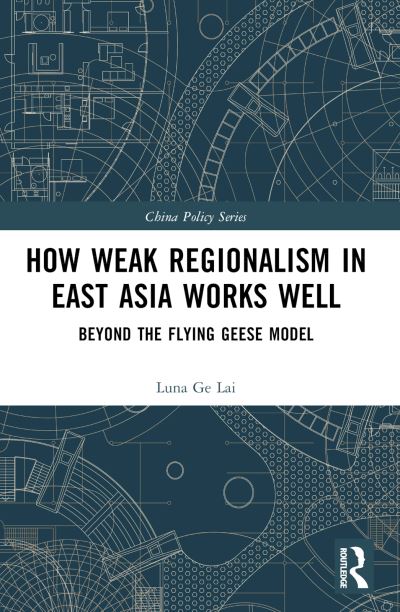
This book investigates the reasons why regionalism in East Asia has been much weaker than in Western Europe and North America. It focuses particularly on economic factors, examining the regional and global linkages of production networks.
Through a focused exploration of regional and global production networks, it argues that East Asia was not as regionally concentrated as was Western Europe or North America, lacking a regionally oriented productional basis to support the institutional arrangement of East Asia as a stand-alone economic community. Moreover, the regional production networks of each national economy in the region are influenced by a different set of value-added components from different global and regional origins. This divergence in their positions accounts for the mushrooming of divergent initiatives and projects for regional institutional arrangement. Finally, the institutional choices of the states to join Comprehensive and Progressive Agreement for Trans-Pacific Partnership (CP/TPP) and/or Regional Comprehensive Economic Partnership (RCEP) are found to be strongly influenced by the sectoral focuses and priorities of their economies.
Demonstrating how the unique economic factors of each nation override other considerations for greater regional integration, this book will be a valuable resource to students and scholars of international trade, Asian politics and economics.
| ISBN: | 9781032613291 |
| Publication date: | 22nd May 2026 |
| Author: | Luna Ge Lai |
| Publisher: | Routledge an imprint of Taylor & Francis |
| Format: | Paperback |
| Pagination: | 206 pages |
| Series: | China Policy Series |
| Genres: |
International trade and commerce International relations Political economy |
This book investigates the reasons why regionalism in East Asia has been much weaker than in Western Europe and North America. It focuses particularly on economic factors, examining the regional and global linkages of production networks.
Through a focused exploration of regional and global production networks, it argues that East Asia was not as regionally concentrated as was Western Europe or North America, lacking a regionally oriented productional basis to support the institutional arrangement of East Asia as a stand-alone economic community. Moreover, the regional production networks of each national economy in the region are influenced by a different set of value-added components from different global and regional origins. This divergence in their positions accounts for the mushrooming of divergent initiatives and projects for regional institutional arrangement. Finally, the institutional choices of the states to join Comprehensive and Progressive Agreement for Trans-Pacific Partnership (CP/TPP) and/or Regional Comprehensive Economic Partnership (RCEP) are found to be strongly influenced by the sectoral focuses and priorities of their economies.
Demonstrating how the unique economic factors of each nation override other considerations for greater regional integration, this book will be a valuable resource to students and scholars of international trade, Asian politics and economics.
How Weak Regionalism in East Asia Works Well features in the following genres: Regional / International studies, International economics, Politics and government
How Weak Regionalism in East Asia Works Well is available in Paperback, Hardback
How Weak Regionalism in East Asia Works Well was written by Luna Ge Lai and published by Routledge an imprint of Taylor & Francis
How Weak Regionalism in East Asia Works Well has 206 pages
Yes it is part of China Policy Series series
£43.19