

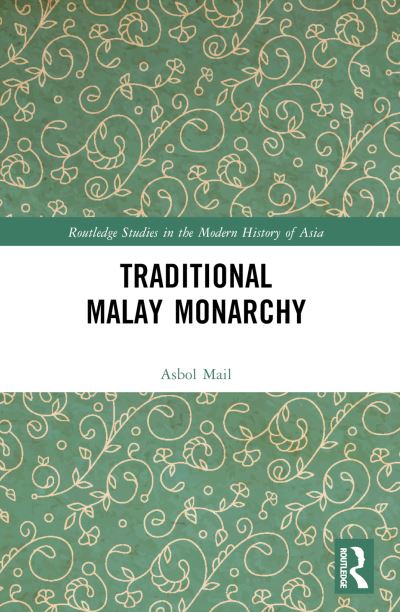
This remarkable book brings to an English-speaking audience detailed scholarship originally conceived and written in the Malay language and with a Malay perspective. It examines the nature of monarchy in the Malay world, which includes present-day Malaysia and Indonesia, before and during the onset of Western colonialism when the Malay world was ruled by a large number of separate Muslim sultanates. It highlights that monarchs were the highest authority in the social, political, legal and economic system, rather than the government of a clearly defined territory; the notion of Dewaraja (god-king) and what a model monarch's attributes should be; and how the monarch's role related to Islamic principles, including the Islamic ideal of the Caliph of God meting out fair judgement and punishment. Two prominent and pivotal concepts of traditional Malay society, that of daulat (sovereignty) and derhaka (disloyalty) are here analysed and evaluated against the background of the period of absolute monarchy. Moreover, this volume also discusses the parts played by leading ministers and viziers, who often exercised enormous power, explores the role of monarchs in managing and regulating economic activity, and outlines differences between the different sultanates.
| ISBN: | 9781032605326 |
| Publication date: | 26th December 2025 |
| Author: | Haji Awg Asbol bin Haji Mail |
| Publisher: | Routledge an imprint of Taylor & Francis |
| Format: | Paperback |
| Pagination: | 212 pages |
| Series: | Routledge Studies in the Modern History of Asia |
| Genres: |
Asian history Regional / International studies |
This remarkable book brings to an English-speaking audience detailed scholarship originally conceived and written in the Malay language and with a Malay perspective. It examines the nature of monarchy in the Malay world, which includes present-day Malaysia and Indonesia, before and during the onset of Western colonialism when the Malay world was ruled by a large number of separate Muslim sultanates. It highlights that monarchs were the highest authority in the social, political, legal and economic system, rather than the government of a clearly defined territory; the notion of Dewaraja (god-king) and what a model monarch's attributes should be; and how the monarch's role related to Islamic principles, including the Islamic ideal of the Caliph of God meting out fair judgement and punishment. Two prominent and pivotal concepts of traditional Malay society, that of daulat (sovereignty) and derhaka (disloyalty) are here analysed and evaluated against the background of the period of absolute monarchy. Moreover, this volume also discusses the parts played by leading ministers and viziers, who often exercised enormous power, explores the role of monarchs in managing and regulating economic activity, and outlines differences between the different sultanates.
Traditional Malay Monarchy features in the following genres: Asian history, Regional / International studies
Traditional Malay Monarchy is available in Paperback
Traditional Malay Monarchy was written by Haji Awg Asbol bin Haji Mail and published by Routledge an imprint of Taylor & Francis
Traditional Malay Monarchy has 212 pages
Yes it is part of Routledge Studies in the Modern History of Asia series
£43.19