

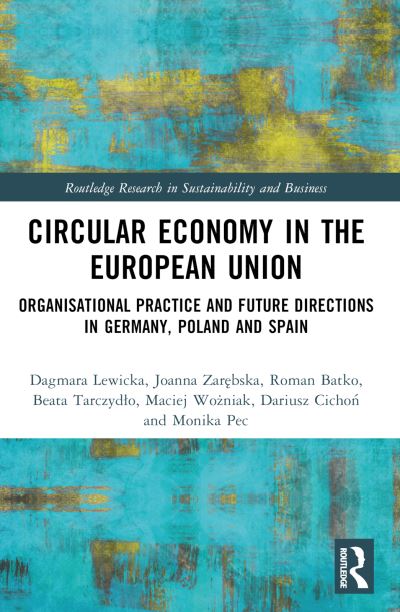
Circular Economy in the European Union: Organisational Practice and Future Directions in Germany, Poland and Spain presents the EU's journey towards a circular economy (CE), identifying significant organisational practices in this gradually adopted field among member countries.
The book also aims to develop and propose innovative initiatives and practices for implementing CE across various economic sectors in selected EU countries, such as Poland, Spain and Germany. Covering topics which include the implementation of CE in the EU and worldwide, green employee behaviors, corporate social responsibility in creating pro-environmental attitudes and models of eco-digital factory transformation in SMEs, the book emphasises the importance of innovative, environmentally friendly, low-waste, and low-emission technologies. Consisting of thirteen interconnected chapters, it discusses the challenges and opportunities of CE, the importance of business engagement in addressing social and environmental problems, and provides practical examples of innovative solutions in various sectors.
This volume will be of great interest to students and scholars of circular economy, corporate governance, business ethics and sustainable business, as well as entrepreneurs, managers, government representatives, and non-governmental organisations active in CE.
| ISBN: | 9781032532769 |
| Publication date: | 6th May 2025 |
| Author: | Dagmara Lewicka |
| Publisher: | Routledge an imprint of Taylor & Francis |
| Format: | Paperback |
| Pagination: | 268 pages |
| Series: | Routledge Research in Sustainability and Business |
| Genres: |
Business and the environment; ‘green’ approaches to business Environmental economics Sociology Sales and marketing Waste management Social impact of environmental issues Civil engineering, surveying and building |
Circular Economy in the European Union: Organisational Practice and Future Directions in Germany, Poland and Spain presents the EU's journey towards a circular economy (CE), identifying significant organisational practices in this gradually adopted field among member countries.
The book also aims to develop and propose innovative initiatives and practices for implementing CE across various economic sectors in selected EU countries, such as Poland, Spain and Germany. Covering topics which include the implementation of CE in the EU and worldwide, green employee behaviors, corporate social responsibility in creating pro-environmental attitudes and models of eco-digital factory transformation in SMEs, the book emphasises the importance of innovative, environmentally friendly, low-waste, and low-emission technologies. Consisting of thirteen interconnected chapters, it discusses the challenges and opportunities of CE, the importance of business engagement in addressing social and environmental problems, and provides practical examples of innovative solutions in various sectors.
This volume will be of great interest to students and scholars of circular economy, corporate governance, business ethics and sustainable business, as well as entrepreneurs, managers, government representatives, and non-governmental organisations active in CE.
Circular Economy in the European Union features in the following genres: Business and the environment; ‘green’ approaches to business, Environmental economics, Sociology, Sales and marketing, Waste management, Social impact of environmental issues, Civil engineering, surveying and building
Circular Economy in the European Union is available in Paperback
Circular Economy in the European Union was written by Dagmara Lewicka and published by Routledge an imprint of Taylor & Francis
Circular Economy in the European Union has 268 pages
Yes it is part of Routledge Research in Sustainability and Business series
£43.19