

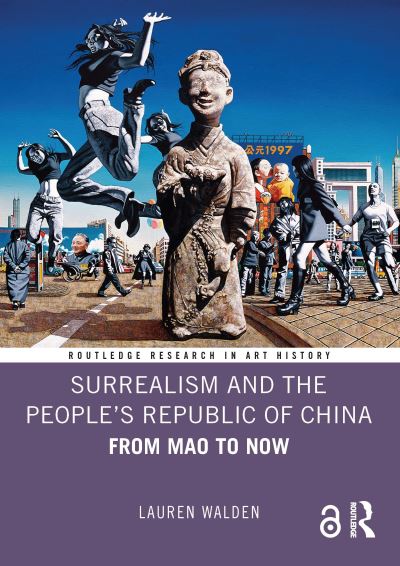
This study investigates cultural exchange between the Surrealist movement and the People's Republic of China (1949-present).
Surrealist art was officially prohibited under Mao's rule (1949-1976). However, the book interrogates potent tensions in clandestinely created surrealist artworks by Zhao Shou and Sha Qi, who discovered the movement while studying abroad. Furthermore, Walden explores how several European Surrealists aligned Chinese calligraphy with automatism as well as Michel Leiris and Marcel Mariën's travels to Maoist China and their diametrically opposed visions of the nation. Amidst post-socialism, the book posits that the '85 New Wave consciously employed Surrealism to process the traumatic Cultural Revolution (1966-1976) and react to newfound societal freedoms. Subsequently, the volume considers why a new artistic tendency of 'surrealist pop' emerged in the 1990s. At present, Lauren Walden reveals how Surrealism has become officialised and even promoted by Chinese authorities owing to revolutionary resonances between traditional Chinese art and the western avant-garde.
The book will be of interest to scholars working in art history, Chinese studies, and Surrealism.
Chapter 4 of this book is freely available as a downloadable Open Access PDF at http://www.taylorfrancis.com under a Creative Commons Attribution-Non Commercial-No Derivatives (CC BY-NC-ND) 4.0 license
| ISBN: | 9781032464671 |
| Publication date: | 13th November 2025 |
| Author: | Lauren Walden |
| Publisher: | Routledge an imprint of Taylor & Francis |
| Format: | Hardback |
| Pagination: | 262 pages |
| Series: | Routledge Research in Art History |
| Genres: |
History of art |
This study investigates cultural exchange between the Surrealist movement and the People's Republic of China (1949-present).
Surrealist art was officially prohibited under Mao's rule (1949-1976). However, the book interrogates potent tensions in clandestinely created surrealist artworks by Zhao Shou and Sha Qi, who discovered the movement while studying abroad. Furthermore, Walden explores how several European Surrealists aligned Chinese calligraphy with automatism as well as Michel Leiris and Marcel Mariën's travels to Maoist China and their diametrically opposed visions of the nation. Amidst post-socialism, the book posits that the '85 New Wave consciously employed Surrealism to process the traumatic Cultural Revolution (1966-1976) and react to newfound societal freedoms. Subsequently, the volume considers why a new artistic tendency of 'surrealist pop' emerged in the 1990s. At present, Lauren Walden reveals how Surrealism has become officialised and even promoted by Chinese authorities owing to revolutionary resonances between traditional Chinese art and the western avant-garde.
The book will be of interest to scholars working in art history, Chinese studies, and Surrealism.
Chapter 4 of this book is freely available as a downloadable Open Access PDF at http://www.taylorfrancis.com under a Creative Commons Attribution-Non Commercial-No Derivatives (CC BY-NC-ND) 4.0 license
Surrealism and the People's Republic of China features in the following genres: History of art, Far-left political ideologies and movements, Social and political philosophy, Theory of art, Asian history, Regional / International studies, Society and culture: general
Surrealism and the People's Republic of China is available in Hardback
Surrealism and the People's Republic of China was written by Lauren Walden and published by Routledge an imprint of Taylor & Francis
Surrealism and the People's Republic of China has 262 pages
Yes it is part of Routledge Research in Art History series
£154.79