

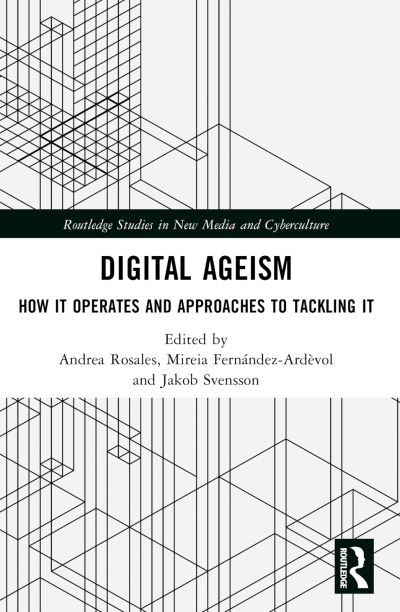
This anthology contributes to creating awareness on how digital ageism operates in relation to the widely spread symbolic representations of old and young age around digital technologies, the (lack of) representation of diverse older individuals in the design, development, and marketing of digital technologies and in the actual algorithms and datasets that constitute them. It also shows how individuals and institutions deal with digital ageism in everyday life.
In the past decades, digital technologies permeated most aspects of everyday life. With a focus on how age is represented and experienced in relation to digital technologies leading to digital ageism, digitalisation's reinforcement of spirals of exclusion and loss of autonomy of some collectives is explored, when it could be natural for a great part of society and represent a sort of improvement.
The book addresses social science students and scholars interested in everyday digital technologies, society and the power struggles about it, providing insights from different parts of the globe. By using different methods and touching upon different aspects of digital ageism and how it plays out in contemporary connected data societies, this volume will raise awareness, challenge power, initiate discussions and spur further research into this field.
The Open Access version of this book, available at www.taylorfrancis.com, has been made available under a Creative Commons Attribution 4.0 license.
| ISBN: | 9781032392141 |
| Publication date: | 28th November 2024 |
| Author: | Andrea Rosales, Mireia FernándezArdèvol, Jakob Svensson |
| Publisher: | Routledge an imprint of Taylor & Francis |
| Format: | Paperback |
| Pagination: | 288 pages |
| Series: | Routledge Studies in New Media and Cyberculture |
| Genres: |
Social groups, communities and identities Media studies: internet, digital media and society Social discrimination and social justice |
This anthology contributes to creating awareness on how digital ageism operates in relation to the widely spread symbolic representations of old and young age around digital technologies, the (lack of) representation of diverse older individuals in the design, development, and marketing of digital technologies and in the actual algorithms and datasets that constitute them. It also shows how individuals and institutions deal with digital ageism in everyday life.
In the past decades, digital technologies permeated most aspects of everyday life. With a focus on how age is represented and experienced in relation to digital technologies leading to digital ageism, digitalisation's reinforcement of spirals of exclusion and loss of autonomy of some collectives is explored, when it could be natural for a great part of society and represent a sort of improvement.
The book addresses social science students and scholars interested in everyday digital technologies, society and the power struggles about it, providing insights from different parts of the globe. By using different methods and touching upon different aspects of digital ageism and how it plays out in contemporary connected data societies, this volume will raise awareness, challenge power, initiate discussions and spur further research into this field.
The Open Access version of this book, available at www.taylorfrancis.com, has been made available under a Creative Commons Attribution 4.0 license.
Digital Ageism features in the following genres: Media studies, Cultural studies, Communication studies, Sociology, Media, entertainment, information and communication industries, Digital and information technologies: social and ethical aspects, Digital and information technologies: Legal aspects, Human–computer interaction, The Arts
Digital Ageism is available in Paperback, Hardback
Digital Ageism was written by Andrea Rosales, Mireia FernándezArdèvol, Jakob Svensson and published by Routledge an imprint of Taylor & Francis
Digital Ageism has 288 pages
Yes it is part of Routledge Studies in New Media and Cyberculture series
£39.59