

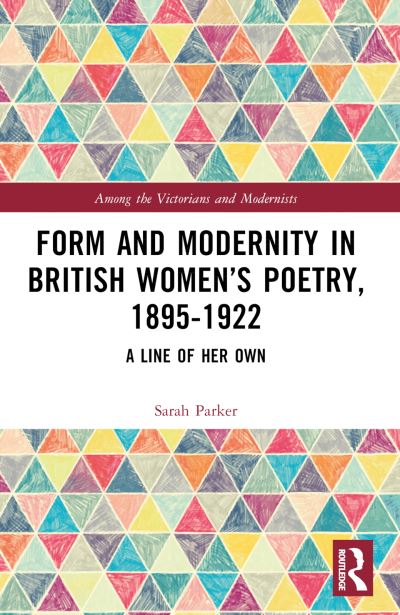
While W. B. Yeats's influential account of the 'Tragic Generation' claims that most fin-de-siècle poets died, or at least stopped writing, shortly after 1900, this book explodes this narrative by attending to the twentieth-century poetry produced by women poets Alice Meynell, Michael Field (Katharine Bradley and Edith Cooper), Dollie Radford, and Katharine Tynan. While primarily associated with the late nineteenth century, these poets were active in the twentieth century, but their later writing is overlooked in modernist-dominated studies, partly due to this poetry's adherence to traditional form. This book reveals that these poets, far from being irrelevant to modernity, used these established forms to address contemporary concerns, including suffrage, sexuality, motherhood, and the First World War. The chapters focus on Meynell's manipulations of metre to contemplate temporality and literary tradition; Michael Field's use of blank verse to portray the conflicted modern woman; Radford's adaptation of the aesthetic song-like lyric to tackle the experience of the city, urban crime, and suffrage; and Tynan's employment of the ballad to soothe bereaved mothers during the First World War. This book ultimately shows that traditional forms played a vital role in shaping mature women poets' responses to modernity, illuminating debates about form, tradition, and gender in twentieth-century poetry.
| ISBN: | 9781032348698 |
| Publication date: | 27th June 2025 |
| Author: | Sarah Parker |
| Publisher: | Routledge an imprint of Taylor & Francis |
| Format: | Paperback |
| Pagination: | 232 pages |
| Series: | Among the Victorians and Modernists |
| Genres: |
Literary theory Literary studies: c 1800 to c 1900 Literary studies: c 1900 to c 2000 |
While W. B. Yeats's influential account of the 'Tragic Generation' claims that most fin-de-siècle poets died, or at least stopped writing, shortly after 1900, this book explodes this narrative by attending to the twentieth-century poetry produced by women poets Alice Meynell, Michael Field (Katharine Bradley and Edith Cooper), Dollie Radford, and Katharine Tynan. While primarily associated with the late nineteenth century, these poets were active in the twentieth century, but their later writing is overlooked in modernist-dominated studies, partly due to this poetry's adherence to traditional form. This book reveals that these poets, far from being irrelevant to modernity, used these established forms to address contemporary concerns, including suffrage, sexuality, motherhood, and the First World War. The chapters focus on Meynell's manipulations of metre to contemplate temporality and literary tradition; Michael Field's use of blank verse to portray the conflicted modern woman; Radford's adaptation of the aesthetic song-like lyric to tackle the experience of the city, urban crime, and suffrage; and Tynan's employment of the ballad to soothe bereaved mothers during the First World War. This book ultimately shows that traditional forms played a vital role in shaping mature women poets' responses to modernity, illuminating debates about form, tradition, and gender in twentieth-century poetry.
Form and Modernity in Women's Poetry, 1895-1922 features in the following genres: Literary theory, Literary studies: c 1800 to c 1900, Literary studies: c 1900 to c 2000
Form and Modernity in Women's Poetry, 1895-1922 is available in Paperback
Form and Modernity in Women's Poetry, 1895-1922 was written by Sarah Parker and published by Routledge an imprint of Taylor & Francis
Form and Modernity in Women's Poetry, 1895-1922 has 232 pages
Yes it is part of Among the Victorians and Modernists series
£43.19