

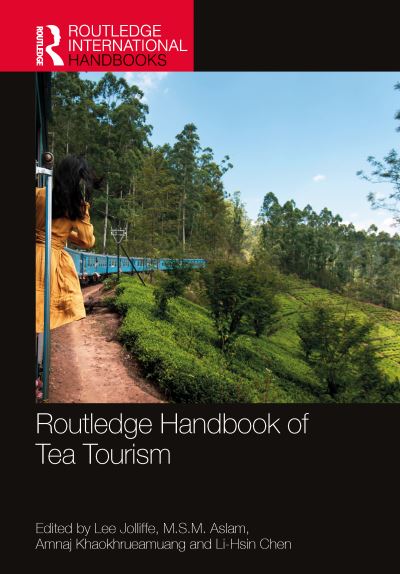
The Routledge Handbook of Tea Tourism provides comprehensive and cutting-edge insights into global tea tourism. With contributions from leading scholars and experts across 19 countries, it demonstrates the interdisciplinary nature and breadth of topics associated with global tea tourism.
Tea is deeply connected to tourism through both travel and consumption. For host communities it provides an opportunity for diversification from the production and/or serving of tea while sharing cultural traditions and improving livelihoods. The Handbook is organised into five parts, with an introduction and epilogue, and the first part begins with an overview of historical and contemporary perspectives on the foundations of tea tourism. It digs into the roots of such tourism in China, the relationship of wild tea to indigenous tourism in Vietnam, heritage railways to tea tourism, and tea tourism in Africa. The second part examines sustainable tea tourism, with examples from Thailand, Turkey, Sri Lanka and India. The third part explores the management and marketing of tea tourism, highlighting tools and techniques for development and the impact of social media on the tea tourism experience. It draws on examples of tea tourism experience in diverse settings, such as the English tea room, a pearl milk tourism factory in Taiwan and a hot spring tea destination in Japan. The fourth part provides perspectives on innovation and practice in tea tourism, such as gastronomical tea tourism in Turkey, Japan and Thailand; tea cafés and community diversification in Japan; the role of GIAHS designation in tea tourism; and tea tour guiding in Iran. Finally, the fifth part provides insights on resilience in tea tourism, examining topics such as human-wildlife conflicts and the impact of the COVID-19 pandemic on the sector in both Asia and Europe.
This Handbook provides a valuable resource for students and researchers, presenting a rich collection of theoretical and empirical insights, an agenda for future directions in the field and end-of-chapter discussion questions. It also serves as a useful tool for key stakeholders, aiming to increase interaction between academia and industry, encouraging the development of sustainable responsible tea tourism that benefits local communities on a global basis.
| ISBN: | 9781032053233 |
| Publication date: | 29th November 2022 |
| Author: | Lee Jolliffe, M S M Aslam, Amnaj Khaokhrueamuang, LiHsin Chen |
| Publisher: | Routledge an imprint of Taylor & Francis |
| Format: | Hardback |
| Pagination: | 340 pages |
| Series: | Routledge International Handbooks |
| Genres: |
Tourism geography Hospitality, sports, leisure and tourism industries |
The Routledge Handbook of Tea Tourism provides comprehensive and cutting-edge insights into global tea tourism. With contributions from leading scholars and experts across 19 countries, it demonstrates the interdisciplinary nature and breadth of topics associated with global tea tourism.
Tea is deeply connected to tourism through both travel and consumption. For host communities it provides an opportunity for diversification from the production and/or serving of tea while sharing cultural traditions and improving livelihoods. The Handbook is organised into five parts, with an introduction and epilogue, and the first part begins with an overview of historical and contemporary perspectives on the foundations of tea tourism. It digs into the roots of such tourism in China, the relationship of wild tea to indigenous tourism in Vietnam, heritage railways to tea tourism, and tea tourism in Africa. The second part examines sustainable tea tourism, with examples from Thailand, Turkey, Sri Lanka and India. The third part explores the management and marketing of tea tourism, highlighting tools and techniques for development and the impact of social media on the tea tourism experience. It draws on examples of tea tourism experience in diverse settings, such as the English tea room, a pearl milk tourism factory in Taiwan and a hot spring tea destination in Japan. The fourth part provides perspectives on innovation and practice in tea tourism, such as gastronomical tea tourism in Turkey, Japan and Thailand; tea cafés and community diversification in Japan; the role of GIAHS designation in tea tourism; and tea tour guiding in Iran. Finally, the fifth part provides insights on resilience in tea tourism, examining topics such as human-wildlife conflicts and the impact of the COVID-19 pandemic on the sector in both Asia and Europe.
This Handbook provides a valuable resource for students and researchers, presenting a rich collection of theoretical and empirical insights, an agenda for future directions in the field and end-of-chapter discussion questions. It also serves as a useful tool for key stakeholders, aiming to increase interaction between academia and industry, encouraging the development of sustainable responsible tea tourism that benefits local communities on a global basis.
Routledge Handbook of Tea Tourism features in the following genres: Hospitality and service industries, Cultural studies: food and society, Food and beverage technology, Agricultural science, Medical sociology, Sociology, Agribusiness and primary industries, Manufacturing industries, Retail and wholesale industries
Routledge Handbook of Tea Tourism is available in Hardback
Routledge Handbook of Tea Tourism was written by Lee Jolliffe, M S M Aslam, Amnaj Khaokhrueamuang, LiHsin Chen and published by Routledge an imprint of Taylor & Francis
Routledge Handbook of Tea Tourism has 340 pages
Yes it is part of Routledge International Handbooks series
£211.50