

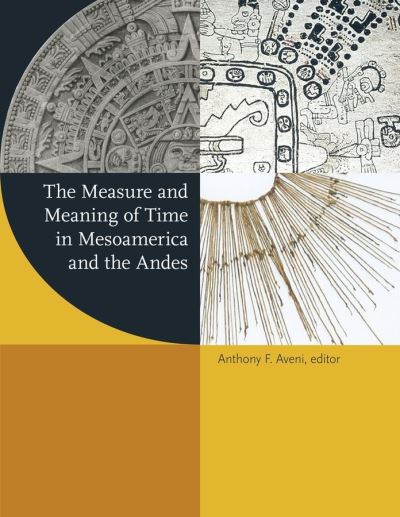
Westerners think of time as a measure of duration, a metric quantity that is continuous, homogeneous, unchangeable, and never ending-a reality that lies outside of human existence. How did the people of Mesoamerica and the Andes, isolated as they were from the rest of the world, conceive of their histories? How and why did they time their rituals? What knowledge can we acquire about their time from studying the material record they have left behind?
This volume brings together specialists in anthropology, archaeology, art history, astronomy, and the history of science to contemplate concrete and abstract temporal concepts gleaned from the Central Mexicans, Mayans, and Andeans. Contributors first address how people reckon and register time; they compare the western linear, progressive way of knowing time with the largely cyclic notions of temporality derived from the Americas, and they dissect, explain, and explore the origins of the complex dynastic and ritual calendars of the Maya, Inca, and Aztecs. They subsequently consider how people sense time and its moral dimensions. Time becomes an inescapable feature of the process of perception, an entity that occupies a succession of moments rather than the knife-edge present ingrained in our Western minds.
| ISBN: | 9780884024033 |
| Publication date: | 2nd June 2015 |
| Author: | Anthony F Aveni |
| Publisher: | Dumbarton Oaks an imprint of Harvard University Press |
| Format: | Hardback |
| Pagination: | 326 pages |
| Series: | Dumbarton Oaks Pre-Columbian Symposia and Colloquia |
| Genres: |
Anthropology Archaeology History of science |
Westerners think of time as a measure of duration, a metric quantity that is continuous, homogeneous, unchangeable, and never ending-a reality that lies outside of human existence. How did the people of Mesoamerica and the Andes, isolated as they were from the rest of the world, conceive of their histories? How and why did they time their rituals? What knowledge can we acquire about their time from studying the material record they have left behind?
This volume brings together specialists in anthropology, archaeology, art history, astronomy, and the history of science to contemplate concrete and abstract temporal concepts gleaned from the Central Mexicans, Mayans, and Andeans. Contributors first address how people reckon and register time; they compare the western linear, progressive way of knowing time with the largely cyclic notions of temporality derived from the Americas, and they dissect, explain, and explore the origins of the complex dynastic and ritual calendars of the Maya, Inca, and Aztecs. They subsequently consider how people sense time and its moral dimensions. Time becomes an inescapable feature of the process of perception, an entity that occupies a succession of moments rather than the knife-edge present ingrained in our Western minds.
The Measure and Meaning of Time in Mesoamerica and the Andes features in the following genres: Anthropology, Archaeology, History of science
The Measure and Meaning of Time in Mesoamerica and the Andes is available in Hardback
The Measure and Meaning of Time in Mesoamerica and the Andes was written by Anthony F Aveni and published by Dumbarton Oaks an imprint of Harvard University Press
The Measure and Meaning of Time in Mesoamerica and the Andes has 326 pages
Yes it is part of Dumbarton Oaks Pre-Columbian Symposia and Colloquia series
£56.66