

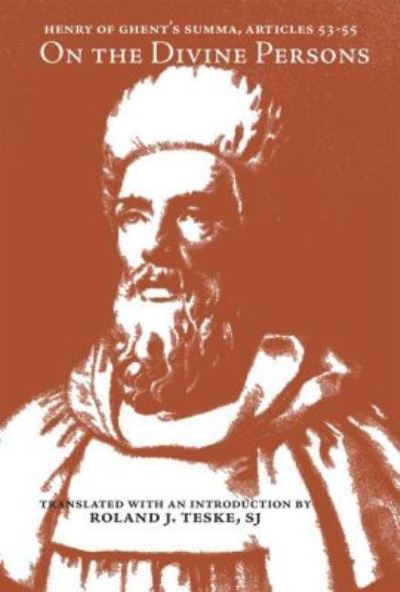
The three articles from Henry of Ghent's Summa of Ordinary Questions translated in this volume are the first that deal with the Trinity.
They follow upon Henry's treatment of the divine attributes in articles forty-one to fifty-two. Article fifty-three asks ten questions about the sense in which a person exists in God, and article fifty-four asks ten questions about the emanations or processions of one divine person from another, while article fifty-five asks six questions about the properties or notions of the divine persons.
Henry was obviously a voracious reader of the Fathers of the Church and the medieval masters of theology in the centuries before him. He cites extensively from Ambrose of Milan, Augustine of Hippo, Boethius, Hilary of Poitiers, Anselm of Canterbury, Peter Lombard, Richard of Saint Victor, and Thomas Aquinas among Western Latin fathers and theologians and from Pseudo-Dionysius and John of Damascus among the Eastern or Greek fathers. But besides such well-known thinkers he cites other masters who are less well-known, such as Praepositinus, Simon of Tournai, Gerard La Pucelle, and Giles of Rome. Henry also quotes such philosophers as Aristotle, Porphyry, and Averroes, who of course have little to say on the Trinity.
Brief introduction to the questions that Henry discusses in each of the three articles: In article fifty-three Henry first of all situates the following questions within his Summa of Ordinary Questions and explains that he will firstly deal with the persons in general in articles fifty-three and fifty-four and then withthe properties or notions of the persons in article fifty-five. Article fifty-three discusses "the manner of the being of persons in God" and article fifty-four is concerned with "the manner of one person's emanating from another."Article fifty-three has ten questions, the first of which is whether one needs to hold that there is a person in God. In his resolution of the question Henry appeals to what he previously established, namely, that we "must attribute to God whatever is without qualification more worthy or better to be than not to be." Appealing to the authority of Richard of Saint Victor, Henry argues that "person" signifies something incommunicable in a rational or intellectual nature and is something of dignity and nobility. Hence, we must hold that there is a person in God.
| ISBN: | 9780874622638 |
| Publication date: | 30th November 2015 |
| Author: | Henry |
| Publisher: | Marquette University Press |
| Format: | Paperback |
| Pagination: | 331 pages |
| Series: | Mediæval Philosophical Texts in Translation |
| Genres: |
Theology Spirituality and religious experience Christianity |
The three articles from Henry of Ghent's Summa of Ordinary Questions translated in this volume are the first that deal with the Trinity.
They follow upon Henry's treatment of the divine attributes in articles forty-one to fifty-two. Article fifty-three asks ten questions about the sense in which a person exists in God, and article fifty-four asks ten questions about the emanations or processions of one divine person from another, while article fifty-five asks six questions about the properties or notions of the divine persons.
Henry was obviously a voracious reader of the Fathers of the Church and the medieval masters of theology in the centuries before him. He cites extensively from Ambrose of Milan, Augustine of Hippo, Boethius, Hilary of Poitiers, Anselm of Canterbury, Peter Lombard, Richard of Saint Victor, and Thomas Aquinas among Western Latin fathers and theologians and from Pseudo-Dionysius and John of Damascus among the Eastern or Greek fathers. But besides such well-known thinkers he cites other masters who are less well-known, such as Praepositinus, Simon of Tournai, Gerard La Pucelle, and Giles of Rome. Henry also quotes such philosophers as Aristotle, Porphyry, and Averroes, who of course have little to say on the Trinity.
Brief introduction to the questions that Henry discusses in each of the three articles: In article fifty-three Henry first of all situates the following questions within his Summa of Ordinary Questions and explains that he will firstly deal with the persons in general in articles fifty-three and fifty-four and then withthe properties or notions of the persons in article fifty-five. Article fifty-three discusses "the manner of the being of persons in God" and article fifty-four is concerned with "the manner of one person's emanating from another."Article fifty-three has ten questions, the first of which is whether one needs to hold that there is a person in God. In his resolution of the question Henry appeals to what he previously established, namely, that we "must attribute to God whatever is without qualification more worthy or better to be than not to be." Appealing to the authority of Richard of Saint Victor, Henry argues that "person" signifies something incommunicable in a rational or intellectual nature and is something of dignity and nobility. Hence, we must hold that there is a person in God.
Henry of Ghent's Summa. Articles 53-55, on the Divine Persons features in the following genres: Theology, Spirituality and religious experience, Christianity
Henry of Ghent's Summa. Articles 53-55, on the Divine Persons is available in Paperback
Henry of Ghent's Summa. Articles 53-55, on the Divine Persons was written by Henry and published by Marquette University Press
Henry of Ghent's Summa. Articles 53-55, on the Divine Persons has 331 pages
Yes it is part of Mediæval Philosophical Texts in Translation series
£19.79