

Sometime between 1028 and 1038, Ibn al-Haytham completed his monumental optical synthesis, Kitab al-Manazir ("Book of Optics"). By no later than 1200, and perhaps somewhat earlier, this treatise appeared in Latin under the title De aspectibus. In that form it was attributed to a certain "Alhacen." These differences in title and authorial designation are indicative of the profound differences between the two versions, Arabic and Latin, of the treatise. In many ways, in fact, they can be regarded not simply as different versions of the same work, but as different works in their own right. Accordingly, the Arab author, Ibn al-Haytham, and his Latin incarnation, Alhacen, represent two distinct, sometimes even conflicting, interpretive voices. And the same holds for their respective texts.
To complicate matters, "Alhacen" does not represent a single interpretive voice. There were at least two translators at work on the Latin text, one of them adhering faithfully to the Arabic original, the other content with distilling, even paraphrasing, the Arabic original. Consequently, the Latin text presents not one, but at least two faces to the reader. This two-volume critical edition represents fourteen years of work on Dr. Smith's part.
Awarded the 2001 J. F. Lewis Award.
| ISBN: | 9780871699145 |
| Publication date: | 10th January 2024 |
| Author: | A Mark Smith |
| Publisher: | American Philosophical Society an imprint of American Philosophical Society Press |
| Format: | Paperback |
| Pagination: | 520 pages |
| Series: | Transactions of the American Philosophical Society |
| Genres: |
Optical physics |
Sometime between 1028 and 1038, Ibn al-Haytham completed his monumental optical synthesis, Kitab al-Manazir ("Book of Optics"). By no later than 1200, and perhaps somewhat earlier, this treatise appeared in Latin under the title De aspectibus. In that form it was attributed to a certain "Alhacen." These differences in title and authorial designation are indicative of the profound differences between the two versions, Arabic and Latin, of the treatise. In many ways, in fact, they can be regarded not simply as different versions of the same work, but as different works in their own right. Accordingly, the Arab author, Ibn al-Haytham, and his Latin incarnation, Alhacen, represent two distinct, sometimes even conflicting, interpretive voices. And the same holds for their respective texts.
To complicate matters, "Alhacen" does not represent a single interpretive voice. There were at least two translators at work on the Latin text, one of them adhering faithfully to the Arabic original, the other content with distilling, even paraphrasing, the Arabic original. Consequently, the Latin text presents not one, but at least two faces to the reader. This two-volume critical edition represents fourteen years of work on Dr. Smith's part.
Awarded the 2001 J. F. Lewis Award.
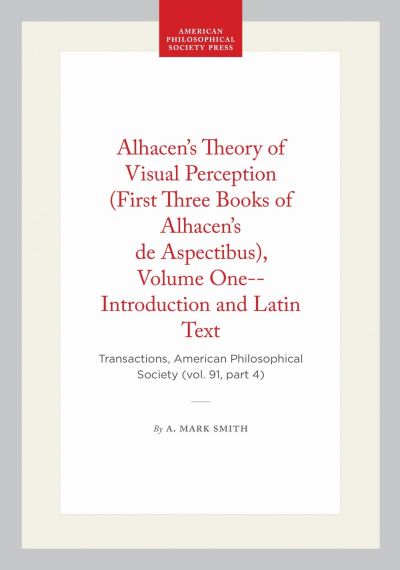
Alhacen's Theory of Visual Perception (First Three Books of Alhacen's De Aspectibus), Volume One--Introduction and Latin Text features in the following genres: Optical physics
Alhacen's Theory of Visual Perception (First Three Books of Alhacen's De Aspectibus), Volume One--Introduction and Latin Text is available in Paperback
Alhacen's Theory of Visual Perception (First Three Books of Alhacen's De Aspectibus), Volume One--Introduction and Latin Text was written by A Mark Smith and published by American Philosophical Society an imprint of American Philosophical Society Press
Alhacen's Theory of Visual Perception (First Three Books of Alhacen's De Aspectibus), Volume One--Introduction and Latin Text has 520 pages
Yes it is part of Transactions of the American Philosophical Society series