

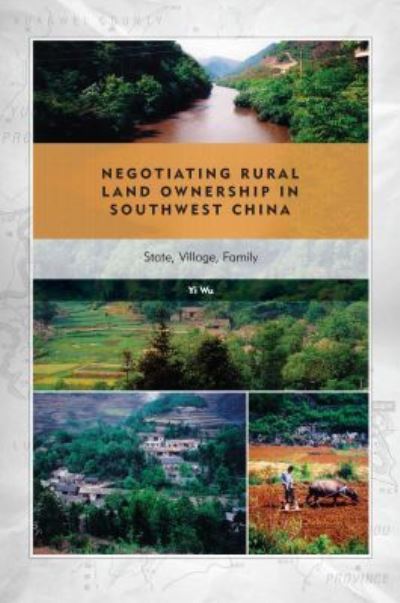
Negotiating Rural Land Ownership in Southwest China offers the first comprehensive analysis of how China's current system of land ownership has evolved over the past six decades. Based on extended fieldwork in Yunnan Province, the author explores how the three major rural actors—local governments, village communities, and rural households—have contested and negotiated land rights at the grassroots level, thereby transforming the structure of rural land ownership in the People's Republic of China.At least two million rural settlements (or "natural villages") are estimated to exist in China today. Formed spontaneously out of settlement choices over extended periods of time, these rural settlements are fundamentally different from the present-day administrative villages imposed by the government from above. Yi Wu's historical ethnography sheds light on such "natural villages" and their role in shaping the current land ownership system. Drawing on local land disputes, archival documents, and rich local histories, the author unveils their enduring social identities in both the Maoist and reform eras. She pioneers the concept of "bounded collectivism" to describe what resulted from struggles between the Chinese state trying to establish collective land ownership, and rural settlements seeking exclusive control over land resources within their traditional borders.A particular contribution of this book is that it provides a nuanced understanding of how and why China's rural land ownership is changing in post-Mao China. Yi Wu uses village-level data to show how local governments, rural communities, and rural households compete for use, income, and transfer rights in both agricultural production and the land market. She demonstrates that the current rural land ownership system in China is not a static system imposed by the state from above, but a constantly changing hybrid.
| ISBN: | 9780824876807 |
| Publication date: | 30th April 2018 |
| Author: | Yi Wu |
| Publisher: | University of Hawai'i Press |
| Format: | Paperback |
| Pagination: | 296 pages |
| Series: | Studies of the Weatherhead East Asian Institute, Columbia University |
| Genres: |
Asian history Population and demography Social and cultural anthropology |
Negotiating Rural Land Ownership in Southwest China offers the first comprehensive analysis of how China's current system of land ownership has evolved over the past six decades. Based on extended fieldwork in Yunnan Province, the author explores how the three major rural actors—local governments, village communities, and rural households—have contested and negotiated land rights at the grassroots level, thereby transforming the structure of rural land ownership in the People's Republic of China.At least two million rural settlements (or "natural villages") are estimated to exist in China today. Formed spontaneously out of settlement choices over extended periods of time, these rural settlements are fundamentally different from the present-day administrative villages imposed by the government from above. Yi Wu's historical ethnography sheds light on such "natural villages" and their role in shaping the current land ownership system. Drawing on local land disputes, archival documents, and rich local histories, the author unveils their enduring social identities in both the Maoist and reform eras. She pioneers the concept of "bounded collectivism" to describe what resulted from struggles between the Chinese state trying to establish collective land ownership, and rural settlements seeking exclusive control over land resources within their traditional borders.A particular contribution of this book is that it provides a nuanced understanding of how and why China's rural land ownership is changing in post-Mao China. Yi Wu uses village-level data to show how local governments, rural communities, and rural households compete for use, income, and transfer rights in both agricultural production and the land market. She demonstrates that the current rural land ownership system in China is not a static system imposed by the state from above, but a constantly changing hybrid.
Negotiating Rural Land Ownership in Southwest China features in the following genres: Asian history, Population and demography, Social and cultural anthropology
Negotiating Rural Land Ownership in Southwest China is available in Paperback, Hardback, Ebook
Negotiating Rural Land Ownership in Southwest China was written by Yi Wu and published by University of Hawai'i Press
Negotiating Rural Land Ownership in Southwest China has 296 pages
Yes it is part of Studies of the Weatherhead East Asian Institute, Columbia University series