

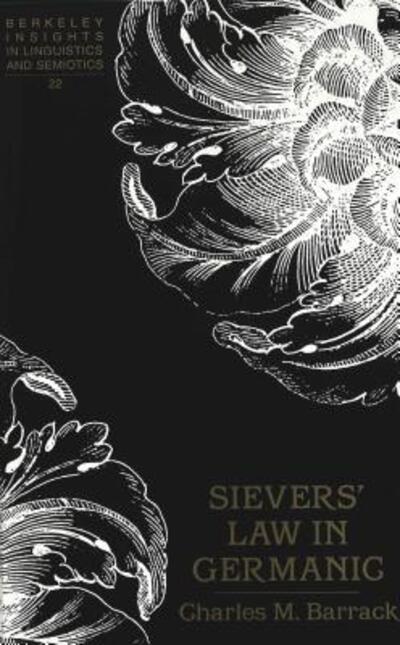
One of the most interesting changes in Proto-Germanic was the alternation of y and w after short syllables with i and u after long, respectively - an alternation with far-reaching effects. Described by Eduard Sievers in 1878, this law has been the subject of controversy ever since. Is it related to a similar phenomenon in Vedic Sanskrit, and was it, therefore, Indo-European in origin? What is its relationship to alliterative verse in Germanic? This study addresses such questions and demonstrates that Sievers' Law has played a wider role in Old English than heretofore demonstrated.
| ISBN: | 9780820430423 |
| Publication date: | 1st March 1998 |
| Author: | Charles Michael Barrack |
| Publisher: | P. Lang an imprint of Lang, Peter, Publishing Inc. |
| Format: | Hardback |
| Pagination: | 288 pages |
| Series: | Berkeley Insights in Linguistics and Semiotics |
| Genres: |
Language: reference and general Language: history and general works Historical and comparative linguistics Literary studies: ancient, classical and medieval |
One of the most interesting changes in Proto-Germanic was the alternation of y and w after short syllables with i and u after long, respectively - an alternation with far-reaching effects. Described by Eduard Sievers in 1878, this law has been the subject of controversy ever since. Is it related to a similar phenomenon in Vedic Sanskrit, and was it, therefore, Indo-European in origin? What is its relationship to alliterative verse in Germanic? This study addresses such questions and demonstrates that Sievers' Law has played a wider role in Old English than heretofore demonstrated.
Sievers' Law in Germanic features in the following genres: Language: reference and general, Language: history and general works, Historical and comparative linguistics, Literary studies: ancient, classical and medieval
Sievers' Law in Germanic is available in Hardback
Sievers' Law in Germanic was written by Charles Michael Barrack and published by P. Lang an imprint of Lang, Peter, Publishing Inc.
Sievers' Law in Germanic has 288 pages
Yes it is part of Berkeley Insights in Linguistics and Semiotics series