

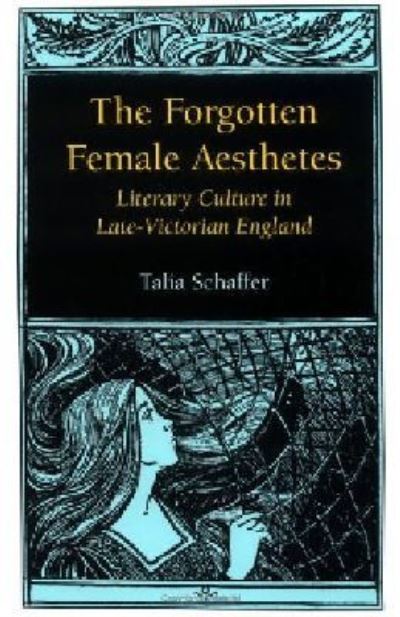
Every non-canonical male aesthete in Victorian England once competed with what Talia Schaffer calls the female aesthetes, whose critical and popular success made them formidable contemporaries. Not only did these women make significant contributions to the development of feminist ideologies, they pioneered new literary strategies that were incorporated by their canonical successors. In this text, Schaffer analyzes writers such as Lucas Malet (Mary Harrison), Ouida (Marie Louise de la Ramee), Alice Meynell, Rosamund Marriott Watson, Una Ashworth Taylor, Elizabeth Robins Pennell, Mary and Jane Findlater, and John Oliver Hobbes (Pearl Craigie). These women used aestheticism to forge a compromise between the two models of female identity available to them - the New Woman and the Angel in the House. They developed plots, ideas, and styles that would later be adopted, parodied, or revised by canonical writers such as Oscar Wilde, Virginia Woolf, Thomas Hardy and Henry James. They used the ""pretty"" language of aestheticism as a strategic cover behind which they could attempt radical experiments, many of which prefigure modernist innovations. Talia Schaffer hopes that recovering the lost work of the female aesthetes will force us to reconsider the central tenets of late-Victorian literary theory.
| ISBN: | 9780813919379 |
| Publication date: | 29th April 2000 |
| Author: | Talia Schaffer |
| Publisher: | University of Virginia Press |
| Format: | Paperback |
| Pagination: | 298 pages |
| Series: | Victorian Literature and Culture Series |
| Genres: |
Literary studies: c 1800 to c 1900 Gender studies: women and girls Philosophy: aesthetics Literary studies: fiction, novelists and prose writers |
Every non-canonical male aesthete in Victorian England once competed with what Talia Schaffer calls the female aesthetes, whose critical and popular success made them formidable contemporaries. Not only did these women make significant contributions to the development of feminist ideologies, they pioneered new literary strategies that were incorporated by their canonical successors. In this text, Schaffer analyzes writers such as Lucas Malet (Mary Harrison), Ouida (Marie Louise de la Ramee), Alice Meynell, Rosamund Marriott Watson, Una Ashworth Taylor, Elizabeth Robins Pennell, Mary and Jane Findlater, and John Oliver Hobbes (Pearl Craigie). These women used aestheticism to forge a compromise between the two models of female identity available to them - the New Woman and the Angel in the House. They developed plots, ideas, and styles that would later be adopted, parodied, or revised by canonical writers such as Oscar Wilde, Virginia Woolf, Thomas Hardy and Henry James. They used the ""pretty"" language of aestheticism as a strategic cover behind which they could attempt radical experiments, many of which prefigure modernist innovations. Talia Schaffer hopes that recovering the lost work of the female aesthetes will force us to reconsider the central tenets of late-Victorian literary theory.
The Forgotten Female Aesthetes features in the following genres: Literary studies: c 1800 to c 1900, Gender studies: women and girls, Philosophy: aesthetics, Literary studies: fiction, novelists and prose writers
The Forgotten Female Aesthetes is available in Hardback, Paperback
The Forgotten Female Aesthetes was written by Talia Schaffer and published by University of Virginia Press
The Forgotten Female Aesthetes has 298 pages
Yes it is part of Victorian Literature and Culture Series series