

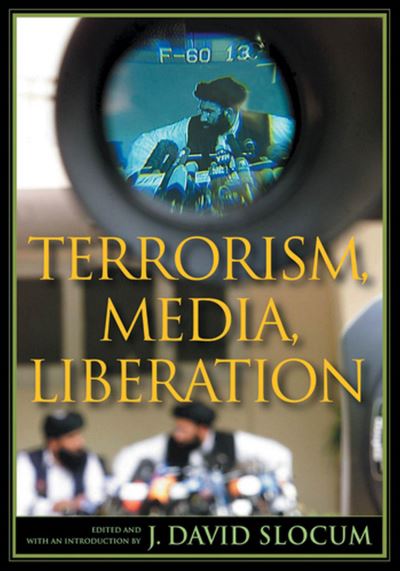
September 11, 2001 made the dangers of terrorism horrifyingly real for Americans. Although not the first or only attack on U.S. soil, its magnitude renewed old debates and raised fresh concerns about the relations between media and such events. How should the news - print, cable, network, radio, Internet - cover stories? What visual evidence does the public have the ""right"" to see and what is not acceptable to show to the viewing public at home? How can - or should - such events be retold cinematically? Bringing together fifteen classic essays by prominent scholars in a variety of fields, including history, international relations, communications, American studies, anthropology, political science, and cultural studies, Terrorism, Media, Liberation explores the relationship between violent political actions and the technological media that present and frame them for mass audiences. Fundamental to the idea of terrorism is the psychological impact that violent acts have on those not directly involved. Essays examine concerns over the creation of spectacle and the propagation of fear and argue that the mediated ways the public learns about these events unavoidably shape our understanding of terrorism as a contemporary threat. With a thoughtful introduction by J. David Slocum, this timely and important collection provides a historical, rather than simplistically moral perspective on the current, thoroughly mediated, ""war on terrorism.
| ISBN: | 9780813536071 |
| Publication date: | 30th June 2005 |
| Author: | J David Slocum |
| Publisher: | Rutgers University Press |
| Format: | Hardback |
| Pagination: | 353 pages |
| Series: | Rutgers Depth of Field Series |
| Genres: |
Media studies Terrorism, armed struggle |
September 11, 2001 made the dangers of terrorism horrifyingly real for Americans. Although not the first or only attack on U.S. soil, its magnitude renewed old debates and raised fresh concerns about the relations between media and such events. How should the news - print, cable, network, radio, Internet - cover stories? What visual evidence does the public have the ""right"" to see and what is not acceptable to show to the viewing public at home? How can - or should - such events be retold cinematically? Bringing together fifteen classic essays by prominent scholars in a variety of fields, including history, international relations, communications, American studies, anthropology, political science, and cultural studies, Terrorism, Media, Liberation explores the relationship between violent political actions and the technological media that present and frame them for mass audiences. Fundamental to the idea of terrorism is the psychological impact that violent acts have on those not directly involved. Essays examine concerns over the creation of spectacle and the propagation of fear and argue that the mediated ways the public learns about these events unavoidably shape our understanding of terrorism as a contemporary threat. With a thoughtful introduction by J. David Slocum, this timely and important collection provides a historical, rather than simplistically moral perspective on the current, thoroughly mediated, ""war on terrorism.
Terrorism, Media, Liberation features in the following genres: Media studies, Terrorism, armed struggle
Terrorism, Media, Liberation is available in Hardback, Paperback
Terrorism, Media, Liberation was written by J David Slocum and published by Rutgers University Press
Terrorism, Media, Liberation has 353 pages
Yes it is part of Rutgers Depth of Field Series series