

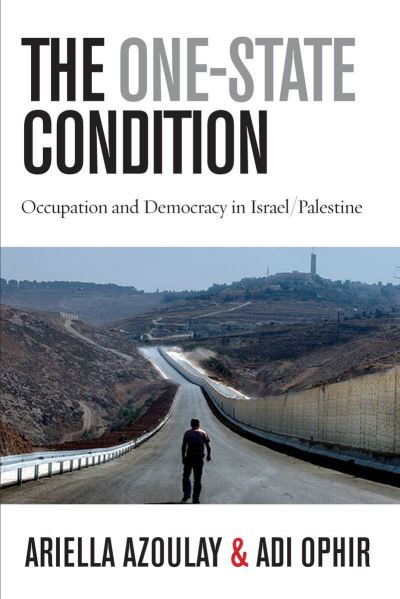
Since the start of the occupation of Palestinian territories in 1967, Israel's domination of the Palestinians has deprived an entire population of any political status or protection. But even decades on, most people speak of this rule-both in everyday political discussion and in legal and academic debates-as temporary, as a state of affairs incidental and external to the Israeli regime. In The One-State Condition, Ariella Azoulay and Adi Ophir directly challenge this belief.
Looking closely at the history and contemporary formation of the ruling apparatus-the technologies and operations of the Israeli army, the General Security Services, and the legal system imposed in the Occupied Territories-Azoulay and Ophir outline the one-state condition of Israel/Palestine: the grounding principle of Israeli governance is the perpetuation of differential rule over populations of differing status. Israeli citizenship is shaped through the active denial of Palestinian citizenship and civil rights.
Though many Israelis, on both political right and left, agree that the occupation constitutes a problem for Israeli democracy, few ultimately admit that Israel is no democracy or question the very structure of the Israeli regime itself. Too frequently ignored are the lasting effects of the deceptive denial of the events of 1948 and 1967, and the ways in which the resulting occupation has reinforced the sweeping militarization and recent racialization of Israeli society. Azoulay and Ophir show that acknowledgment of the one-state condition is not only a prerequisite for considering a one- or two-state solution; it is a prerequisite for advancing new ideas to move beyond the trap of this false dilemma.
| ISBN: | 9780804775922 |
| Publication date: | 28th November 2012 |
| Author: | Ariella Azoulay, Adi Ophir |
| Publisher: | Stanford University Press |
| Format: | Paperback |
| Pagination: | 316 pages |
| Series: | Stanford Studies in Middle Eastern and Islamic Societies and Cultures |
| Genres: |
Social and political philosophy |
Since the start of the occupation of Palestinian territories in 1967, Israel's domination of the Palestinians has deprived an entire population of any political status or protection. But even decades on, most people speak of this rule-both in everyday political discussion and in legal and academic debates-as temporary, as a state of affairs incidental and external to the Israeli regime. In The One-State Condition, Ariella Azoulay and Adi Ophir directly challenge this belief.
Looking closely at the history and contemporary formation of the ruling apparatus-the technologies and operations of the Israeli army, the General Security Services, and the legal system imposed in the Occupied Territories-Azoulay and Ophir outline the one-state condition of Israel/Palestine: the grounding principle of Israeli governance is the perpetuation of differential rule over populations of differing status. Israeli citizenship is shaped through the active denial of Palestinian citizenship and civil rights.
Though many Israelis, on both political right and left, agree that the occupation constitutes a problem for Israeli democracy, few ultimately admit that Israel is no democracy or question the very structure of the Israeli regime itself. Too frequently ignored are the lasting effects of the deceptive denial of the events of 1948 and 1967, and the ways in which the resulting occupation has reinforced the sweeping militarization and recent racialization of Israeli society. Azoulay and Ophir show that acknowledgment of the one-state condition is not only a prerequisite for considering a one- or two-state solution; it is a prerequisite for advancing new ideas to move beyond the trap of this false dilemma.
The One-State Condition features in the following genres: Social and political philosophy
The One-State Condition is available in Hardback, Paperback
The One-State Condition was written by Ariella Azoulay, Adi Ophir and published by Stanford University Press
The One-State Condition has 316 pages
Yes it is part of Stanford Studies in Middle Eastern and Islamic Societies and Cultures series