

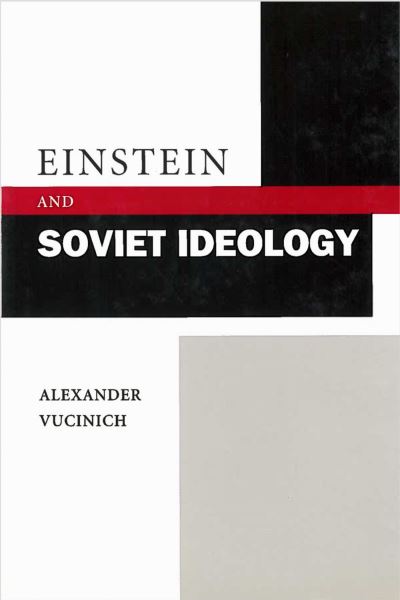
This book traces the historical trajectory of one of the most momentous confrontations in the intellectual life of the Soviet Union-the conflict between Einstein's theory of relativity and official Soviet ideology embodied in dialectical materialism.
Soviet attitudes toward Einstein's scientific and philosophical thought passed through several stages. During the pre-Stalin era, Marxist philosophers clashed over the problem of defining dialectical materialism in relation to the ongoing revolution in science. This controversy produced a full spectrum of Marxist attitudes toward the theory of relativity, ranging from complete acceptance to total rejection. Disunity also prevented Marxist writers from interfering with the work of those Soviet physicists who produced a rich literature extolling the theory of relativity.
During the Stalin era (1929-1953), conflicting forces in Marxist thinking were eliminated, and complete unity was established and firmly guarded by the state. Marxist theorists declared war on "idealistic" principles built into Einstein's scientific work. State harassment of leading physicists accused of idealistic digressions persisted throughout the Stalinist era. Several leading proponents of Einstein's ideas perished in political prisons. Despite all these pressures, some leading physicists used every opportunity to reaffirm their fundamental agreement with the theory of relativity as one of the fundamental contributions to twentieth-century scientific thought.
The post-Stalinist period (1953-1985) gradually evolved into a profound transformation of every domain of social and cultural life, and Einstein's scientific and philosophical legacy was no exception. Whereas Stalinist writers tried to reformulate Einstein's principles to accommodate dialectical materialism, post-Stalinist thinkers, much more familiar with modern physics than their predecessors, attempted to make Marxist philosophy sufficiently flexible to absorb the guiding principles of the theory of relativity. A wide range of Einstein's ideas, previously regarded as symptoms of bourgeois decadence, was now hailed as a cornerstone of the Marxist philosophy of science. The post-Stalinist era also produced an extensive and appreciative literature on the humanistic aspect of Einstein's thought.
The short-lived period of perestroika (1985-1991) accelerated the de-Stalinization process, post-Stalinist gains were solidified, and the theory of relativity was increasingly shorn of ideological burdens, thus removing one of the last remnants of the Stalinist war on science.
| ISBN: | 9780804742092 |
| Publication date: | 1st August 2002 |
| Author: | Alexander Vucinich |
| Publisher: | Stanford University Press |
| Format: | Hardback |
| Pagination: | 291 pages |
| Series: | Stanford Nuclear Age Series |
| Genres: |
History of science |
This book traces the historical trajectory of one of the most momentous confrontations in the intellectual life of the Soviet Union-the conflict between Einstein's theory of relativity and official Soviet ideology embodied in dialectical materialism.
Soviet attitudes toward Einstein's scientific and philosophical thought passed through several stages. During the pre-Stalin era, Marxist philosophers clashed over the problem of defining dialectical materialism in relation to the ongoing revolution in science. This controversy produced a full spectrum of Marxist attitudes toward the theory of relativity, ranging from complete acceptance to total rejection. Disunity also prevented Marxist writers from interfering with the work of those Soviet physicists who produced a rich literature extolling the theory of relativity.
During the Stalin era (1929-1953), conflicting forces in Marxist thinking were eliminated, and complete unity was established and firmly guarded by the state. Marxist theorists declared war on "idealistic" principles built into Einstein's scientific work. State harassment of leading physicists accused of idealistic digressions persisted throughout the Stalinist era. Several leading proponents of Einstein's ideas perished in political prisons. Despite all these pressures, some leading physicists used every opportunity to reaffirm their fundamental agreement with the theory of relativity as one of the fundamental contributions to twentieth-century scientific thought.
The post-Stalinist period (1953-1985) gradually evolved into a profound transformation of every domain of social and cultural life, and Einstein's scientific and philosophical legacy was no exception. Whereas Stalinist writers tried to reformulate Einstein's principles to accommodate dialectical materialism, post-Stalinist thinkers, much more familiar with modern physics than their predecessors, attempted to make Marxist philosophy sufficiently flexible to absorb the guiding principles of the theory of relativity. A wide range of Einstein's ideas, previously regarded as symptoms of bourgeois decadence, was now hailed as a cornerstone of the Marxist philosophy of science. The post-Stalinist era also produced an extensive and appreciative literature on the humanistic aspect of Einstein's thought.
The short-lived period of perestroika (1985-1991) accelerated the de-Stalinization process, post-Stalinist gains were solidified, and the theory of relativity was increasingly shorn of ideological burdens, thus removing one of the last remnants of the Stalinist war on science.
Einstein and Soviet Ideology features in the following genres: History of science
Einstein and Soviet Ideology is available in Hardback
Einstein and Soviet Ideology was written by Alexander Vucinich and published by Stanford University Press
Einstein and Soviet Ideology has 291 pages
Yes it is part of Stanford Nuclear Age Series series