

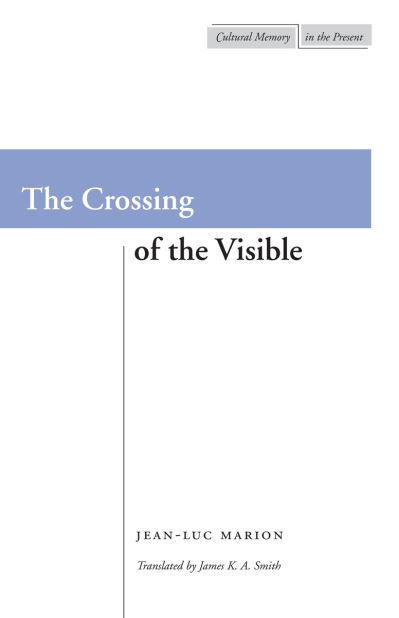
Painting, according to Jean-Luc Marion, is a central topic of concern for philosophy, particularly phenomenology. For the question of painting is, at its heart, a question of visibility-of appearance. As such, the painting is a privileged case of the phenomenon; the painting becomes an index for investigating the conditions of appearance-or what Marion describes as "phenomenality" in general.
In The Crossing of the Visible, Marion takes up just such a project. The natural outgrowth of his earlier reflections on icons, these four studies carefully consider the history of painting-from classical to contemporary-as a fund for phenomenological reflection on the conditions of (in)visibility. Ranging across artists from Raphael to Rothko, Caravaggio to Pollock, The Crossing of the Visible offers both a critique of contemporary accounts of the visual and a constructive alternative. According to Marion, the proper response to the "nihilism" of postmodernity is not iconoclasm, but rather a radically iconic account of the visual and the arts that opens them to the invisible.
| ISBN: | 9780804733915 |
| Publication date: | 18th December 2003 |
| Author: | JeanLuc Marion |
| Publisher: | Stanford University Press |
| Format: | Hardback |
| Pagination: | 99 pages |
| Series: | Cultural Memory in the Present |
| Genres: |
Painting, drawing and art manuals |
Painting, according to Jean-Luc Marion, is a central topic of concern for philosophy, particularly phenomenology. For the question of painting is, at its heart, a question of visibility-of appearance. As such, the painting is a privileged case of the phenomenon; the painting becomes an index for investigating the conditions of appearance-or what Marion describes as "phenomenality" in general.
In The Crossing of the Visible, Marion takes up just such a project. The natural outgrowth of his earlier reflections on icons, these four studies carefully consider the history of painting-from classical to contemporary-as a fund for phenomenological reflection on the conditions of (in)visibility. Ranging across artists from Raphael to Rothko, Caravaggio to Pollock, The Crossing of the Visible offers both a critique of contemporary accounts of the visual and a constructive alternative. According to Marion, the proper response to the "nihilism" of postmodernity is not iconoclasm, but rather a radically iconic account of the visual and the arts that opens them to the invisible.
The Crossing of the Visible features in the following genres: Painting, drawing and art manuals
The Crossing of the Visible is available in Hardback, Paperback
The Crossing of the Visible was written by JeanLuc Marion and published by Stanford University Press
The Crossing of the Visible has 99 pages
Yes it is part of Cultural Memory in the Present series