

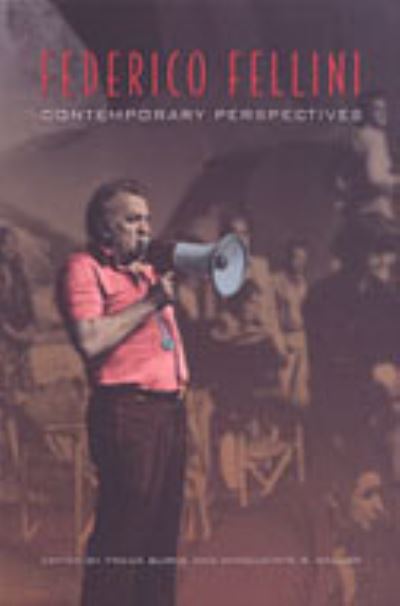
Federico Fellini remains the best known of the postwar Italian directors. This collection of essays brings Fellini criticism up to date, employing a range of recent critical filters, including semiotic, psychoanalytical, feminist and deconstructionist. Accordingly, a number of important themes arise - the reception of fascism, the crisis of the subject, the question of agency, homo-eroticism, feminism, and constructions of gender.
Since the early 1970s, a slide in critical and theoretical attention to Fellini's work has corresponded with an assumption that his films are self-indulgent and lacking in political value. This volume moves the discussion towards a politics of signification, contending that Fellini's evolving self-reflexivity is not mere solipsism but rather a critique of both aesthetics and signification. The essays presented here are almost all new - the two exceptions being important signifiers in Fellini studies. The first, Frank Burke's "Federico Fellini: Reality/Representation/Signification" laid the foundation in the late 1980s for considering Fellini's work in the light of postmodernism. The second, Marguerite Waller's "Whose Dolce Vita is this Anyway?: The Language of Fellini's Cinema" (1990), provides a contemporary re-reading of Fellini's most successful film.
This lively and ambitious collection brings a new critical language to bear on Fellini's films, offering fresh insights into their underlying issues and meaning. In bringing Fellini criticism up to date, it will have a significant impact on film studies, reclaiming this important director for a contemporary audience.
| ISBN: | 9780802006967 |
| Publication date: | 8th June 2002 |
| Author: | Frank Burke, Marguerite R Waller |
| Publisher: | University of Toronto Press |
| Format: | Hardback |
| Pagination: | 239 pages |
| Series: | Toronto Italian Studies |
| Genres: |
Films, cinema Film history, theory or criticism Filmmaking and production: technical and background skills |
Federico Fellini remains the best known of the postwar Italian directors. This collection of essays brings Fellini criticism up to date, employing a range of recent critical filters, including semiotic, psychoanalytical, feminist and deconstructionist. Accordingly, a number of important themes arise - the reception of fascism, the crisis of the subject, the question of agency, homo-eroticism, feminism, and constructions of gender.
Since the early 1970s, a slide in critical and theoretical attention to Fellini's work has corresponded with an assumption that his films are self-indulgent and lacking in political value. This volume moves the discussion towards a politics of signification, contending that Fellini's evolving self-reflexivity is not mere solipsism but rather a critique of both aesthetics and signification. The essays presented here are almost all new - the two exceptions being important signifiers in Fellini studies. The first, Frank Burke's "Federico Fellini: Reality/Representation/Signification" laid the foundation in the late 1980s for considering Fellini's work in the light of postmodernism. The second, Marguerite Waller's "Whose Dolce Vita is this Anyway?: The Language of Fellini's Cinema" (1990), provides a contemporary re-reading of Fellini's most successful film.
This lively and ambitious collection brings a new critical language to bear on Fellini's films, offering fresh insights into their underlying issues and meaning. In bringing Fellini criticism up to date, it will have a significant impact on film studies, reclaiming this important director for a contemporary audience.
Federico Fellini features in the following genres: Films, cinema, Film history, theory or criticism, Filmmaking and production: technical and background skills
Federico Fellini is available in Paperback, Hardback
Federico Fellini was written by Frank Burke, Marguerite R Waller and published by University of Toronto Press
Federico Fellini has 239 pages
Yes it is part of Toronto Italian Studies series