

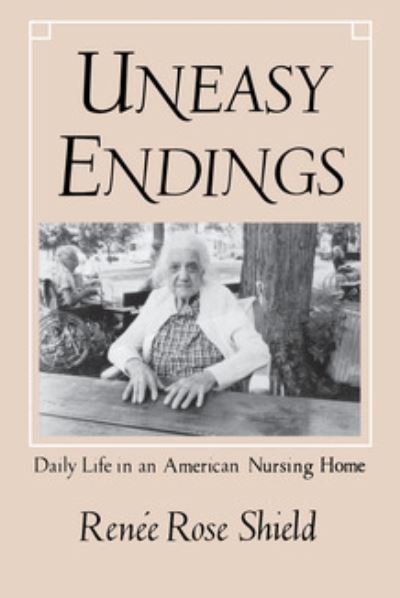
"If we continue, we grow old, and this is how it could be for us," writes Renée Rose Shield in her candid and sympathetic account of life in one American nursing home. Drawing on anthropological methods and theory to illuminate institutional life, she probes the sources of the profound sense of unease she found at the place she calls "The Franklin Nursing Home."For fourteen months Shield participated in life at a nursing home in the northeastern United States. She got to know many of the people associated with the home-doctors, nurses, custodians, kitchen workers, administrators, social workers, visiting relatives, and above all, the residents, who emerge in this book as the individuals they are. Sections in which the residents speak poignantly in their own voices are woven throughout her richly detailed observations of everyday routines and events. We see them using guile and humor to get by, struggling to approach the end of their lives with a measure of autonomy and dignity, and we meet an often conscientious and caring staff constrained by conflicting professional perspectives and by the bureaucratic structure in which they work.There are no villains here. Rather, Shield explains how conditions in the nursing home create a difficult and uncomfortable "liminality"-the transition from an accustomed role to a new one-for the residents. In characterizing nursing-home existence, she goes beyond Erving Goffman's classic definition of the "total institution" to show how residents pass from adulthood to death without the comfort of ritual or community support common in rites of passage. In addition to the isolation created by this solitary passage, she finds restrictions on "reciprocity"-the old people are always recipients whose need and obligation to repay are seen as unnecessary and difficult to satisfy. The system encourages their passivity, which deepens their dependency and helps to explain why they are often perceived as children. Offering concrete suggestions for improving the quality of nursing-home life, Uneasy Endings will find a broad audience among those who work with the aged.
| ISBN: | 9780801494901 |
| Publication date: | 29th December 1988 |
| Author: | Renée Rose Shield |
| Publisher: | Cornell University Press |
| Format: | Paperback |
| Pagination: | 243 pages |
| Series: | Cornell Paperbacks |
| Genres: |
Social and cultural anthropology Age groups: the elderly Community nursing Health systems and services Geriatric medicine Nursing |
"If we continue, we grow old, and this is how it could be for us," writes Renée Rose Shield in her candid and sympathetic account of life in one American nursing home. Drawing on anthropological methods and theory to illuminate institutional life, she probes the sources of the profound sense of unease she found at the place she calls "The Franklin Nursing Home."For fourteen months Shield participated in life at a nursing home in the northeastern United States. She got to know many of the people associated with the home-doctors, nurses, custodians, kitchen workers, administrators, social workers, visiting relatives, and above all, the residents, who emerge in this book as the individuals they are. Sections in which the residents speak poignantly in their own voices are woven throughout her richly detailed observations of everyday routines and events. We see them using guile and humor to get by, struggling to approach the end of their lives with a measure of autonomy and dignity, and we meet an often conscientious and caring staff constrained by conflicting professional perspectives and by the bureaucratic structure in which they work.There are no villains here. Rather, Shield explains how conditions in the nursing home create a difficult and uncomfortable "liminality"-the transition from an accustomed role to a new one-for the residents. In characterizing nursing-home existence, she goes beyond Erving Goffman's classic definition of the "total institution" to show how residents pass from adulthood to death without the comfort of ritual or community support common in rites of passage. In addition to the isolation created by this solitary passage, she finds restrictions on "reciprocity"-the old people are always recipients whose need and obligation to repay are seen as unnecessary and difficult to satisfy. The system encourages their passivity, which deepens their dependency and helps to explain why they are often perceived as children. Offering concrete suggestions for improving the quality of nursing-home life, Uneasy Endings will find a broad audience among those who work with the aged.
Uneasy Endings features in the following genres: Social and cultural anthropology, Age groups: the elderly, Community nursing, Health systems and services, Geriatric medicine, Nursing
Uneasy Endings is available in Paperback, Hardback
Uneasy Endings was written by Renée Rose Shield and published by Cornell University Press
Uneasy Endings has 243 pages
Yes it is part of Cornell Paperbacks series