

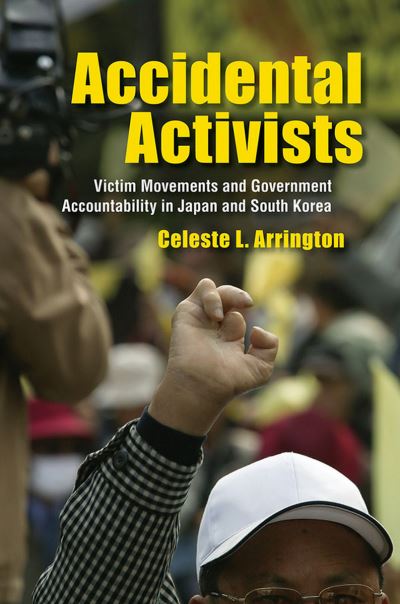
Government wrongdoing or negligence harms people worldwide, but not all victims are equally effective at obtaining redress. In Accidental Activists, Celeste L. Arrington examines the interactive dynamics of the politics of redress to understand why not. Relatively powerless groups like redress claimants depend on support from political elites, active groups in society, the media, experts, lawyers, and the interested public to capture democratic policymakers' attention and sway their decisions. Focusing on when and how such third-party support matters, Arrington finds that elite allies may raise awareness about the victims' cause or sponsor special legislation, but their activities also tend to deter the mobilization of fellow claimants and public sympathy. By contrast, claimants who gain elite allies only after the difficult and potentially risky process of mobilizing societal support tend to achieve more redress, which can include official inquiries, apologies, compensation, and structural reforms.
Arrington draws on her extensive fieldwork to illustrate these dynamics through comparisons of the parallel Japanese and South Korean movements of victims of harsh leprosy control policies, blood products tainted by hepatitis C, and North Korean abductions. Her book thereby highlights how citizens in Northeast Asia-a region grappling with how to address Japan's past wrongs-are leveraging similar processes to hold their own governments accountable for more recent harms. Accidental Activists also reveals the growing power of litigation to promote policy change and greater accountability from decision makers.
| ISBN: | 9780801453762 |
| Publication date: | 1st March 2016 |
| Author: | Celeste L Arrington |
| Publisher: | Cornell University Press |
| Format: | Hardback |
| Pagination: | 248 pages |
| Series: | Studies of the Weatherhead East Asian Institute, Columbia University |
| Genres: |
Political activism / Political engagement Pressure groups, protest movements and non-violent action Comparative politics Asian history |
Government wrongdoing or negligence harms people worldwide, but not all victims are equally effective at obtaining redress. In Accidental Activists, Celeste L. Arrington examines the interactive dynamics of the politics of redress to understand why not. Relatively powerless groups like redress claimants depend on support from political elites, active groups in society, the media, experts, lawyers, and the interested public to capture democratic policymakers' attention and sway their decisions. Focusing on when and how such third-party support matters, Arrington finds that elite allies may raise awareness about the victims' cause or sponsor special legislation, but their activities also tend to deter the mobilization of fellow claimants and public sympathy. By contrast, claimants who gain elite allies only after the difficult and potentially risky process of mobilizing societal support tend to achieve more redress, which can include official inquiries, apologies, compensation, and structural reforms.
Arrington draws on her extensive fieldwork to illustrate these dynamics through comparisons of the parallel Japanese and South Korean movements of victims of harsh leprosy control policies, blood products tainted by hepatitis C, and North Korean abductions. Her book thereby highlights how citizens in Northeast Asia-a region grappling with how to address Japan's past wrongs-are leveraging similar processes to hold their own governments accountable for more recent harms. Accidental Activists also reveals the growing power of litigation to promote policy change and greater accountability from decision makers.
Accidental Activists features in the following genres: Political activism / Political engagement, Pressure groups, protest movements and non-violent action, Comparative politics, Asian history
Accidental Activists is available in Hardback, Ebook
Accidental Activists was written by Celeste L Arrington and published by Cornell University Press
Accidental Activists has 248 pages
Yes it is part of Studies of the Weatherhead East Asian Institute, Columbia University series