

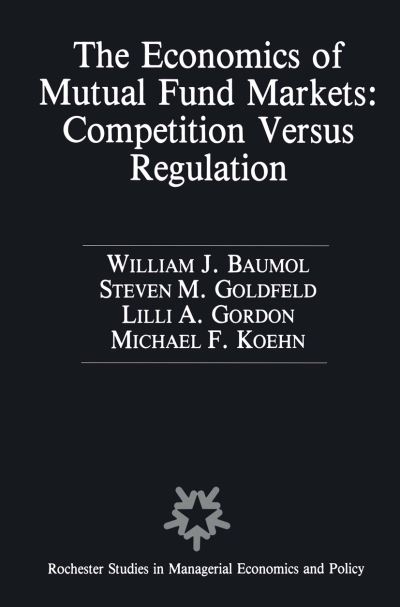
The original impetus for this research was provided several years ago by a request to assist Counsel for Fidelity Management and Research Corporation in analyzing the mutual fund industry, with particular emphasis on money market mutual funds. We were asked to focus our efforts on the mechanism by which the advisory fees of mutual funds are determined. This request arose out of litigation that challenged the level of advisory fees charged to the shareholders of the Fidelity Cash Reserve Fund. Subsequently, we were asked to provide similar assistance to Counsel for T. Rowe Price Associates regarding the fees charged to shareholders of their Prime Reserve Fund. 1940, advisers of Under the Investment Company Act of mutual funds have a fiduciary duty with respect to the level of fees they may charge a fund's shareholders. Since the passage of the Investment Company Act, there have been numerous lawsuits brought by shareholders alleging that advisory fees were excessive. In these lawsuits, the courts have failed to provide a set of standards for determining when such fees are excessive. Instead, they have relied on arbitrary and frequently ill-defined criteria for jUdging the reasonableness of fees. This failure to apply economic-based tests for evaluating the fee structure of mutual funds provided the motivation for the present book, which undertakes a comprehensive analysis of the economics of the mutual fund industry.
| ISBN: | 9780792390435 |
| Publication date: | 31st December 1989 |
| Author: | William J Baumol |
| Publisher: | Springer an imprint of Springer Netherlands |
| Format: | Hardback |
| Pagination: | 236 pages |
| Series: | Rochester Studies in Economics and Policy Issues |
| Genres: |
Finance and the finance industry Macroeconomics Economics of industrial organization |
The original impetus for this research was provided several years ago by a request to assist Counsel for Fidelity Management and Research Corporation in analyzing the mutual fund industry, with particular emphasis on money market mutual funds. We were asked to focus our efforts on the mechanism by which the advisory fees of mutual funds are determined. This request arose out of litigation that challenged the level of advisory fees charged to the shareholders of the Fidelity Cash Reserve Fund. Subsequently, we were asked to provide similar assistance to Counsel for T. Rowe Price Associates regarding the fees charged to shareholders of their Prime Reserve Fund. 1940, advisers of Under the Investment Company Act of mutual funds have a fiduciary duty with respect to the level of fees they may charge a fund's shareholders. Since the passage of the Investment Company Act, there have been numerous lawsuits brought by shareholders alleging that advisory fees were excessive. In these lawsuits, the courts have failed to provide a set of standards for determining when such fees are excessive. Instead, they have relied on arbitrary and frequently ill-defined criteria for jUdging the reasonableness of fees. This failure to apply economic-based tests for evaluating the fee structure of mutual funds provided the motivation for the present book, which undertakes a comprehensive analysis of the economics of the mutual fund industry.
The Economics of Mutual Fund Markets features in the following genres: Finance and the finance industry, Macroeconomics, Economics of industrial organization
The Economics of Mutual Fund Markets is available in Hardback
The Economics of Mutual Fund Markets was written by William J Baumol and published by Springer an imprint of Springer Netherlands
The Economics of Mutual Fund Markets has 236 pages
Yes it is part of Rochester Studies in Economics and Policy Issues series