

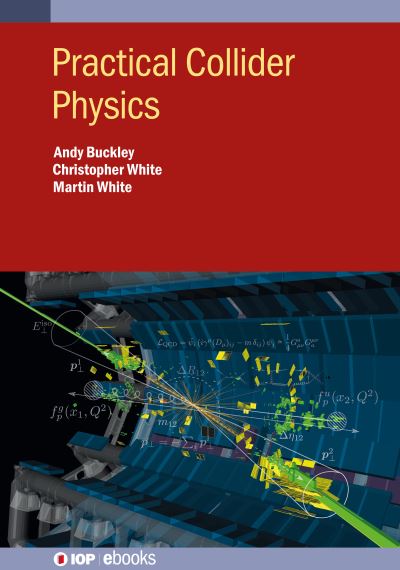
Practical Collider Physics provides a self-contained summary of all of the necessary theoretical, experimental and statistical knowledge required to analyse hadron collider data, focussing on the skills and techniques that are rarely covered in standard textbooks. It covers topics including parton distribution functions, resummation, parton showers, hadronisation, and the underlying event and jet algorithms, all of which are vital for understanding the form and function of Monte Carlo generators. A detailed overview of the ATLAS and CMS detectors is also provided, along with their object-reconstruction algorithms, followed by a pedagogical introduction to computing and data-processing approaches, data-analysis basics, and detailed methods for high-precision measurements and particle searches. This book is appropriate for honours-level undergraduates and masters students, as well as supporting taught-course and practical aspects of a PhD in particle physics.
Key Features
| ISBN: | 9780750324427 |
| Publication date: | 22nd December 2021 |
| Author: | Andy Buckley, Chris White, Martin White |
| Publisher: | IOP Publishing an imprint of Institute of Physics Publishing |
| Format: | Hardback |
| Pagination: | 508 pages |
| Series: | IOP Ebooks |
| Genres: |
Particle and high-energy physics Atomic and molecular physics |
Practical Collider Physics provides a self-contained summary of all of the necessary theoretical, experimental and statistical knowledge required to analyse hadron collider data, focussing on the skills and techniques that are rarely covered in standard textbooks. It covers topics including parton distribution functions, resummation, parton showers, hadronisation, and the underlying event and jet algorithms, all of which are vital for understanding the form and function of Monte Carlo generators. A detailed overview of the ATLAS and CMS detectors is also provided, along with their object-reconstruction algorithms, followed by a pedagogical introduction to computing and data-processing approaches, data-analysis basics, and detailed methods for high-precision measurements and particle searches. This book is appropriate for honours-level undergraduates and masters students, as well as supporting taught-course and practical aspects of a PhD in particle physics.
Key Features
Practical Collider Physics features in the following genres: Particle and high-energy physics, Atomic and molecular physics
Practical Collider Physics is available in Hardback
Practical Collider Physics was written by Andy Buckley, Chris White, Martin White and published by IOP Publishing an imprint of Institute of Physics Publishing
Practical Collider Physics has 508 pages
Yes it is part of IOP Ebooks series