

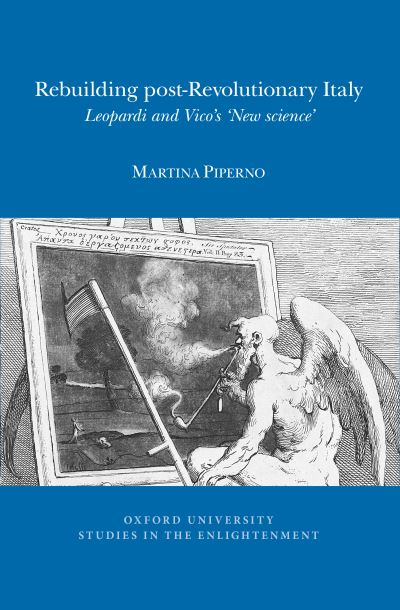
Co-Winner of the Modern Language Association's Aldo and Jeanne Scaglione Prize for Italian Studies, 2018.
The rediscovery of the thought of Giambattista Vico (1668-1774) - especially his New science - is a post-Revolutionary phenomenon. Stressing the elements that keep society together by promoting a sense of belonging, Vico's philosophy helped shape a new Italian identity and intellectual class. Poet and philosopher Giacomo Leopardi (1798-1837) responded perceptively to the spreading and manipulation of Vico's ideas, but to what extent can he be considered Vico's heir?
Through examining the reasons behind the success of the New science in early nineteenth-century Italy, Martina Piperno uncovers the cultural trends, debates, and obsessions fostered by Vico's work. She reconstructs the penetration of Vico-related discourses in circles and environments frequented by Leopardi, and establishes and analyses a latent Vico-Leopardi relationship. Her highly original reading sees Leopardi reacting to the tensions of his time, receiving Vico's message indirectly without a need to draw directly from the source. By exploring the oblique influence of Vico's thought on Leopardi, Martina Piperno highlights the unique character of Italian modernity and its tendency to renegotiate tradition and innovation, past and future.
| ISBN: | 9780729412087 |
| Publication date: | 30th April 2018 |
| Author: | Martina Piperno |
| Publisher: | Voltaire Foundation |
| Format: | Paperback |
| Pagination: | 284 pages |
| Series: | Oxford University Studies in the Enlightenment |
| Genres: |
Philosophical traditions and schools of thought Literary studies: general |
Co-Winner of the Modern Language Association's Aldo and Jeanne Scaglione Prize for Italian Studies, 2018.
The rediscovery of the thought of Giambattista Vico (1668-1774) - especially his New science - is a post-Revolutionary phenomenon. Stressing the elements that keep society together by promoting a sense of belonging, Vico's philosophy helped shape a new Italian identity and intellectual class. Poet and philosopher Giacomo Leopardi (1798-1837) responded perceptively to the spreading and manipulation of Vico's ideas, but to what extent can he be considered Vico's heir?
Through examining the reasons behind the success of the New science in early nineteenth-century Italy, Martina Piperno uncovers the cultural trends, debates, and obsessions fostered by Vico's work. She reconstructs the penetration of Vico-related discourses in circles and environments frequented by Leopardi, and establishes and analyses a latent Vico-Leopardi relationship. Her highly original reading sees Leopardi reacting to the tensions of his time, receiving Vico's message indirectly without a need to draw directly from the source. By exploring the oblique influence of Vico's thought on Leopardi, Martina Piperno highlights the unique character of Italian modernity and its tendency to renegotiate tradition and innovation, past and future.
Rebuilding Post-Revolutionary Italy features in the following genres: Philosophical traditions and schools of thought, Literary studies: general
Rebuilding Post-Revolutionary Italy is available in Paperback
Rebuilding Post-Revolutionary Italy was written by Martina Piperno and published by Voltaire Foundation
Rebuilding Post-Revolutionary Italy has 284 pages
Yes it is part of Oxford University Studies in the Enlightenment series