

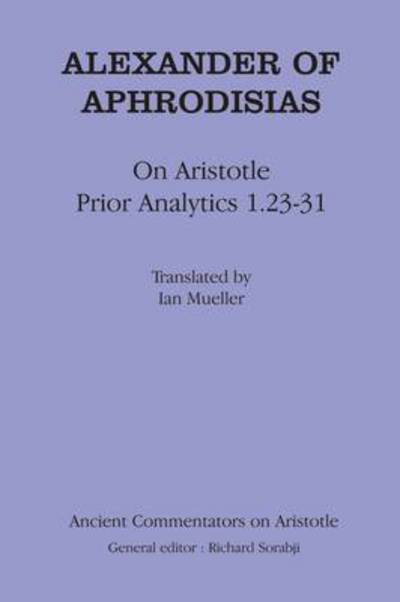
Until the launch of this series over fifteen years ago, the 15,000 volumes of the ancient Greek commentators on Aristotle, written mainly between 200 and 600 AD, constituted the largest corpus of extant Greek philosophical writings not translated into English or other European languages. Over 40 volumes have now appeared in the series, which is planned in some 80 volumes altogether. In the second half of book 1 of the "Prior Analytics", Aristotle reflects on the application of the formalized logic he has developed in the first half, focusing particularly on the non-modal or assertoric syllogistic developed in the first seven chapters. These reflections lead Alexander of Aphrodisias, the great late second-century AD exponent of Aristotelianism, to explain and sometimes argue against subsequent developments of Aristotle's logic and alternatives and objections to it, ideas associated mainly with his colleague Theophrastus and with the Stoics. The other main topic of this part of the "Prior Analytics" is the specification of a method for discovering true premises needed to prove a given proposition.;Aristotle's presentation is sometimes difficult to follow, and Alexander's discussion is extremely helpful to the uninitiated reader. In his commentary on the final chapter translated in this volume, Alexander provides an insightful account of Aristotle's criticism of Plato's method of division.
| ISBN: | 9780715634073 |
| Publication date: | 27th January 2006 |
| Author: | Alexander, Ian Mueller |
| Publisher: | Duckworth |
| Format: | Hardback |
| Pagination: | 184 pages |
| Series: | Ancient Commentators on Aristotle |
| Genres: |
Philosophy: logic |
Until the launch of this series over fifteen years ago, the 15,000 volumes of the ancient Greek commentators on Aristotle, written mainly between 200 and 600 AD, constituted the largest corpus of extant Greek philosophical writings not translated into English or other European languages. Over 40 volumes have now appeared in the series, which is planned in some 80 volumes altogether. In the second half of book 1 of the "Prior Analytics", Aristotle reflects on the application of the formalized logic he has developed in the first half, focusing particularly on the non-modal or assertoric syllogistic developed in the first seven chapters. These reflections lead Alexander of Aphrodisias, the great late second-century AD exponent of Aristotelianism, to explain and sometimes argue against subsequent developments of Aristotle's logic and alternatives and objections to it, ideas associated mainly with his colleague Theophrastus and with the Stoics. The other main topic of this part of the "Prior Analytics" is the specification of a method for discovering true premises needed to prove a given proposition.;Aristotle's presentation is sometimes difficult to follow, and Alexander's discussion is extremely helpful to the uninitiated reader. In his commentary on the final chapter translated in this volume, Alexander provides an insightful account of Aristotle's criticism of Plato's method of division.
Alexander of Aphrodisias on Aristotle Prior Analytics 1.23-31 features in the following genres: Philosophy: logic
Alexander of Aphrodisias on Aristotle Prior Analytics 1.23-31 is available in Hardback
Alexander of Aphrodisias on Aristotle Prior Analytics 1.23-31 was written by Alexander, Ian Mueller and published by Duckworth
Alexander of Aphrodisias on Aristotle Prior Analytics 1.23-31 has 184 pages
Yes it is part of Ancient Commentators on Aristotle series
£117.00