

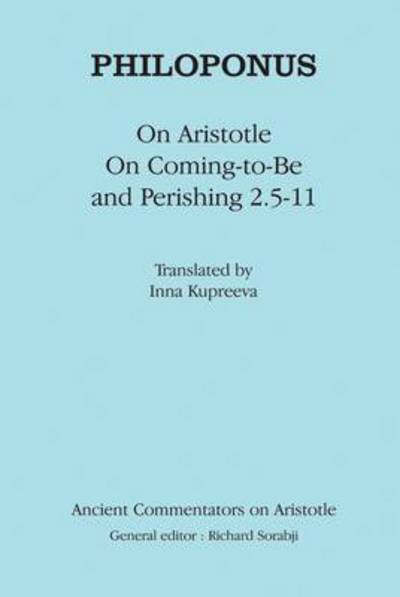
Until the launch of this series over ten years ago, the 15,000 volumes of the ancient Greek commentators on Aristotle, written mainly between 200 and 600 AD, constituted the largest corpus of extant Greek philosophical writings not translated into English or other European languages. Over 30 volumes have now appeared in the series, which is planned in some 60 volumes altogether. Subjects covered in this, the third and last, volume of translation of this work include: why the elements are four in number; what's wrong with Empedocles' theory of elements; how homogeneous stuffs, particularly the tissues of a living body, come to be and consist of the elements. The volume also contains very important discussions of causes, particularly of efficient cause, and of necessity in the sphere of generation and corruption.;It will be of interest to the students of ancient philosophy and science (the commentary draws on earlier philosophical and medical texts); of Patristics and Christian Theology (it allows comparison of Philoponus' later creationist doctrine with his earlier ideas about generation); of medieval philosophy (this text was known to the Arabs; it is used by Avicenna and Averroes); and to anyone with interest in the metaphysics of causation, emergence, necessity and determinism.
| ISBN: | 9780715633045 |
| Publication date: | 25th August 2005 |
| Author: | John Philoponus, Inna Kupreeva |
| Publisher: | Duckworth |
| Format: | Hardback |
| Pagination: | 226 pages |
| Series: | Ancient Commentators on Aristotle |
| Genres: |
Ancient Greek and Roman philosophy |
Until the launch of this series over ten years ago, the 15,000 volumes of the ancient Greek commentators on Aristotle, written mainly between 200 and 600 AD, constituted the largest corpus of extant Greek philosophical writings not translated into English or other European languages. Over 30 volumes have now appeared in the series, which is planned in some 60 volumes altogether. Subjects covered in this, the third and last, volume of translation of this work include: why the elements are four in number; what's wrong with Empedocles' theory of elements; how homogeneous stuffs, particularly the tissues of a living body, come to be and consist of the elements. The volume also contains very important discussions of causes, particularly of efficient cause, and of necessity in the sphere of generation and corruption.;It will be of interest to the students of ancient philosophy and science (the commentary draws on earlier philosophical and medical texts); of Patristics and Christian Theology (it allows comparison of Philoponus' later creationist doctrine with his earlier ideas about generation); of medieval philosophy (this text was known to the Arabs; it is used by Avicenna and Averroes); and to anyone with interest in the metaphysics of causation, emergence, necessity and determinism.
On Aristotle, On Coming-to-Be, and Perishing 2.5-11 features in the following genres: Ancient Greek and Roman philosophy
On Aristotle, On Coming-to-Be, and Perishing 2.5-11 is available in Hardback
On Aristotle, On Coming-to-Be, and Perishing 2.5-11 was written by John Philoponus, Inna Kupreeva and published by Duckworth
On Aristotle, On Coming-to-Be, and Perishing 2.5-11 has 226 pages
Yes it is part of Ancient Commentators on Aristotle series