

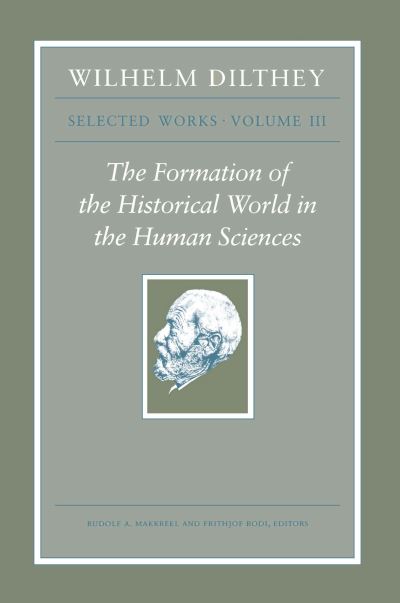
This volume provides Dilthey's most mature and best formulation of his Critique of Historical Reason. It begins with three "Studies Toward the Foundation of the Human Sciences," in which Dilthey refashions Husserlian concepts to describe the basic structures of consciousness relevant to historical understanding.
The volume next presents the major 1910 work The Formation of the Historical World in the Human Sciences. Here Dilthey considers the degree to which carriers of history--individuals, cultures, institutions, and communities--can be articulated as productive systems capable of generating value and meaning and of realizing purposes. Hegel's idea of objective spirit is reconceived in a more empirical form to designate the medium of commonality in which historical beings are immersed. Any universal claims about history need to be framed within the specific productive systems analyzed by the various human sciences. Dilthey's drafts for the Continuation of the Formation contain extensive discussions of the categories most important for our knowledge of historical life: meaning, value, purpose, time, and development. He also examines the contributions of autobiography to historical understanding and of biography to scientific history.
The finest summary of Dilthey's views on hermeneutics can be found in "The Understanding of Other Persons and Their Manifestations of Life." Here, Dilthey differentiates understanding relative to three kinds of manifestations of life. After giving his analysis of elementary understanding, he examines the role of induction in higher understanding and interpretation, and the relevance of transposition and re-experiencing for grasping individuality.
| ISBN: | 9780691149332 |
| Publication date: | 1st October 2010 |
| Author: | Wilhelm Dilthey, Rudolf A Makkreel, Frithjof Rodi |
| Publisher: | Princeton University Press |
| Format: | Paperback |
| Pagination: | 399 pages |
| Series: | Selected Works |
| Genres: |
Ethics and moral philosophy Historiography Society and culture: general |
This volume provides Dilthey's most mature and best formulation of his Critique of Historical Reason. It begins with three "Studies Toward the Foundation of the Human Sciences," in which Dilthey refashions Husserlian concepts to describe the basic structures of consciousness relevant to historical understanding.
The volume next presents the major 1910 work The Formation of the Historical World in the Human Sciences. Here Dilthey considers the degree to which carriers of history--individuals, cultures, institutions, and communities--can be articulated as productive systems capable of generating value and meaning and of realizing purposes. Hegel's idea of objective spirit is reconceived in a more empirical form to designate the medium of commonality in which historical beings are immersed. Any universal claims about history need to be framed within the specific productive systems analyzed by the various human sciences. Dilthey's drafts for the Continuation of the Formation contain extensive discussions of the categories most important for our knowledge of historical life: meaning, value, purpose, time, and development. He also examines the contributions of autobiography to historical understanding and of biography to scientific history.
The finest summary of Dilthey's views on hermeneutics can be found in "The Understanding of Other Persons and Their Manifestations of Life." Here, Dilthey differentiates understanding relative to three kinds of manifestations of life. After giving his analysis of elementary understanding, he examines the role of induction in higher understanding and interpretation, and the relevance of transposition and re-experiencing for grasping individuality.
The Formation of the Historical World in the Human Sciences features in the following genres: Ethics and moral philosophy, Historiography, Society and culture: general
The Formation of the Historical World in the Human Sciences is available in Paperback
The Formation of the Historical World in the Human Sciences was written by Wilhelm Dilthey, Rudolf A Makkreel, Frithjof Rodi and published by Princeton University Press
The Formation of the Historical World in the Human Sciences has 399 pages
Yes it is part of Selected Works series