

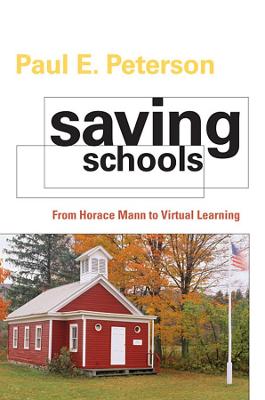
Saving Schools traces the story of the rise, decline, and potential resurrection of American public schools through the lives and ideas of six mission-driven reformers: Horace Mann, John Dewey, Martin Luther King Jr., Albert Shanker, William Bennett, and James Coleman. Yet schools did not become the efficient, egalitarian, and high-quality educational institutions these reformers envisioned. Indeed, the unintended consequences of their legacies shaped today’s flawed educational system, in which political control of stagnant American schools has shifted away from families and communities to larger, more centralized entities—initially to bigger districts and eventually to control by states, courts, and the federal government. Peterson’s tales help to explain how nation building, progressive education, the civil rights movement, unionization, legalization, special education, bilingual teaching, accountability, vouchers, charters, and homeschooling have, each in a different way, set the stage for a new era in American education. Now, under the impact of rising cost, coupled with the possibilities unleashed by technological innovation, schooling may be transformed through virtual learning. The result could be a personalized, customized system of education in which families have greater choice and control over their children’s education than at any time since our nation was founded.
| ISBN: | 9780674062153 |
| Publication date: | 30th November 2011 |
| Author: | Paul E Peterson |
| Publisher: | The Belknap Press an imprint of Harvard University Press |
| Format: | Paperback |
| Pagination: | 336 pages |
| Genres: |
Educational strategies and policy Central / national / federal government policies History: specific events and topics Educational administration and organization Philosophy and theory of education |
Saving Schools traces the story of the rise, decline, and potential resurrection of American public schools through the lives and ideas of six mission-driven reformers: Horace Mann, John Dewey, Martin Luther King Jr., Albert Shanker, William Bennett, and James Coleman. Yet schools did not become the efficient, egalitarian, and high-quality educational institutions these reformers envisioned. Indeed, the unintended consequences of their legacies shaped today’s flawed educational system, in which political control of stagnant American schools has shifted away from families and communities to larger, more centralized entities—initially to bigger districts and eventually to control by states, courts, and the federal government. Peterson’s tales help to explain how nation building, progressive education, the civil rights movement, unionization, legalization, special education, bilingual teaching, accountability, vouchers, charters, and homeschooling have, each in a different way, set the stage for a new era in American education. Now, under the impact of rising cost, coupled with the possibilities unleashed by technological innovation, schooling may be transformed through virtual learning. The result could be a personalized, customized system of education in which families have greater choice and control over their children’s education than at any time since our nation was founded.
Saving Schools features in the following genres: Educational strategies and policy, Central / national / federal government policies, History: specific events and topics, Educational administration and organization, Philosophy and theory of education
Saving Schools is available in Paperback
Saving Schools was written by Paul E Peterson and published by The Belknap Press an imprint of Harvard University Press
Saving Schools has 336 pages