

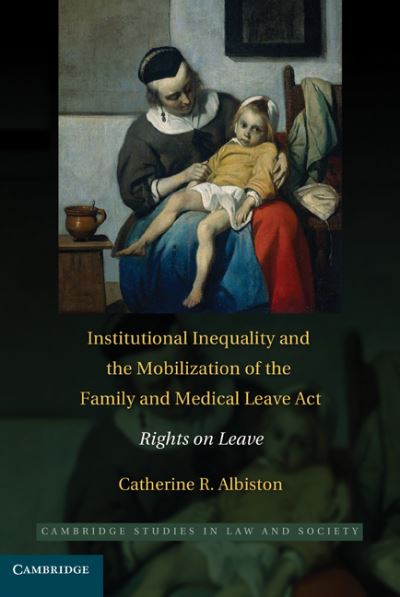
How do Family and Medical Leave Act rights operate in practice in the courts and in the workplace? This empirical study examines how institutions and social practices transform the meaning of these rights to recreate inequality. Workplace rules and norms built around the family wage ideal, the assumption that disability and work are mutually exclusive, and management's historical control over time all constrain opportunities for social change. Yet workers can also mobilize rights as a cultural discourse to change the social meaning of family and medical leave. Drawing on theoretical frameworks from social constructivism and new institutionalism, this study explains how institutions transform rights to recreate systems of power and inequality but at the same time also provide opportunities for law to change social structure. It provides a fresh look at the perennial debate about law and social change by examining how institutions shape the process of rights mobilization.
| ISBN: | 9780521878975 |
| Publication date: | 7th October 2010 |
| Author: | Catherine Ruth Albiston |
| Publisher: | Cambridge University Press |
| Format: | Hardback |
| Pagination: | 291 pages |
| Series: | Cambridge Studies in Law and Society |
| Genres: |
Laws of specific jurisdictions and specific areas of law Law and society, sociology of law Employment and labour law: general |
How do Family and Medical Leave Act rights operate in practice in the courts and in the workplace? This empirical study examines how institutions and social practices transform the meaning of these rights to recreate inequality. Workplace rules and norms built around the family wage ideal, the assumption that disability and work are mutually exclusive, and management's historical control over time all constrain opportunities for social change. Yet workers can also mobilize rights as a cultural discourse to change the social meaning of family and medical leave. Drawing on theoretical frameworks from social constructivism and new institutionalism, this study explains how institutions transform rights to recreate systems of power and inequality but at the same time also provide opportunities for law to change social structure. It provides a fresh look at the perennial debate about law and social change by examining how institutions shape the process of rights mobilization.
Institutional Inequality and the Mobilization of the Family and Medical Leave Act features in the following genres: Laws of specific jurisdictions and specific areas of law, Law and society, sociology of law, Employment and labour law: general
Institutional Inequality and the Mobilization of the Family and Medical Leave Act is available in Hardback
Institutional Inequality and the Mobilization of the Family and Medical Leave Act was written by Catherine Ruth Albiston and published by Cambridge University Press
Institutional Inequality and the Mobilization of the Family and Medical Leave Act has 291 pages
Yes it is part of Cambridge Studies in Law and Society series