

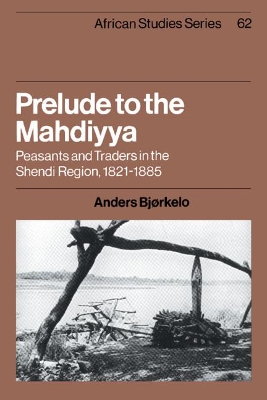
During the first colonial period (the Turkiyya, 1821–85), the Shendi region of the Northern Sudan was inhabited by peasants, traders and nomads. This book analyses socio-economic change among the peasants and traders during this formative period of Sudanese history. Administration, agriculture and trade in transition from a pre-colonial to a colonial economy are discussed. Anders Bjørkelo argues that Turkish demands for cash-crop cultivation and taxation in cash ruined the villages and towns and undermined the local subsistence economy, and that the role of traders as mediators in the process of monetisation contributed to stagnation and rural indebtedness. By combining a thorough mastery of the travel literature with examination of previously unknown manuscript sources, notably the private papers of a prominent Sudanese merchant, he is able to offer a closer view of the situation of trader and peasant families. For the first time it is possible to consider the period from a Sudanese point of view. Dr Bjørkelo concludes that General Gordon's policy of driving back to the impoverished north the waves of emigrants to the Southern Sudan was instrumental in triggering off the Mahdist movement, and also interestingly suggests points of comparison between reactions to Muslim, as against European, imperialism.
| ISBN: | 9780521534444 |
| Publication date: | 13th February 2003 |
| Author: | Anders Bjørkelo |
| Publisher: | Cambridge University Press |
| Format: | Paperback |
| Pagination: | 212 pages |
| Series: | African Studies |
| Genres: |
General and world history Social and cultural history |
During the first colonial period (the Turkiyya, 1821–85), the Shendi region of the Northern Sudan was inhabited by peasants, traders and nomads. This book analyses socio-economic change among the peasants and traders during this formative period of Sudanese history. Administration, agriculture and trade in transition from a pre-colonial to a colonial economy are discussed. Anders Bjørkelo argues that Turkish demands for cash-crop cultivation and taxation in cash ruined the villages and towns and undermined the local subsistence economy, and that the role of traders as mediators in the process of monetisation contributed to stagnation and rural indebtedness. By combining a thorough mastery of the travel literature with examination of previously unknown manuscript sources, notably the private papers of a prominent Sudanese merchant, he is able to offer a closer view of the situation of trader and peasant families. For the first time it is possible to consider the period from a Sudanese point of view. Dr Bjørkelo concludes that General Gordon's policy of driving back to the impoverished north the waves of emigrants to the Southern Sudan was instrumental in triggering off the Mahdist movement, and also interestingly suggests points of comparison between reactions to Muslim, as against European, imperialism.
Prelude to the Mahdiyya features in the following genres: General and world history, Social and cultural history
Prelude to the Mahdiyya is available in Paperback, Hardback
Prelude to the Mahdiyya was written by Anders Bjørkelo and published by Cambridge University Press
Prelude to the Mahdiyya has 212 pages
Yes it is part of African Studies series
£30.60