

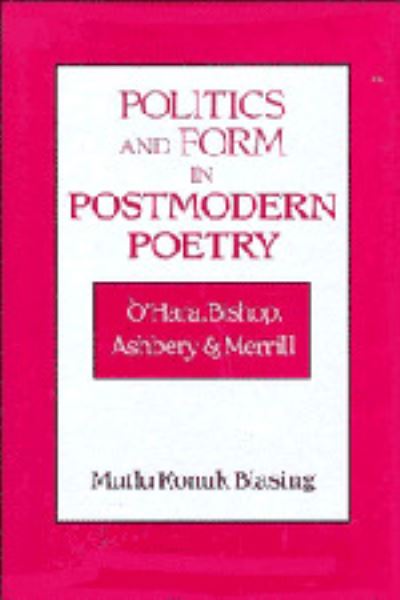
Approaching post-World War II poetry from a postmodern critical perspective, this study challenges the prevailing assumption that experimental forms signify political opposition while traditional forms are politically conservative. Such essentialist alignments of forms with extra-formal values, and the oppositional framework of innovation versus conservation that they yield, reflect modernist biases inappropriate for reading postwar poetry. Biasing defines postmodern poetry as a break with modernism's valorization of technique and its implicit collusion with technological progress. She shows that four major postwar poets - Frank O'Hara, Elizabeth Bishop, John Ashbery and James Merrill (two traditional and two experimental) - cannot be read as politically conservative because formally traditional or as culturally oppositional because formally experimental. All of these poets acknowledge that no one form is more natural than another, and no given form grants them a superior position for judging cultural and political arrangements. Their work plays an important cultural role precisely by revealing that meanings and values do not inhere in forms but are always and irreducibly rhetorical.
| ISBN: | 9780521496070 |
| Publication date: | 3rd July 1996 |
| Author: | Mutlu Konuk Blasing |
| Publisher: | Cambridge University Press |
| Format: | Hardback |
| Pagination: | 219 pages |
| Series: | Cambridge Studies in American Literature and Culture |
| Genres: |
Literary studies: general |
Approaching post-World War II poetry from a postmodern critical perspective, this study challenges the prevailing assumption that experimental forms signify political opposition while traditional forms are politically conservative. Such essentialist alignments of forms with extra-formal values, and the oppositional framework of innovation versus conservation that they yield, reflect modernist biases inappropriate for reading postwar poetry. Biasing defines postmodern poetry as a break with modernism's valorization of technique and its implicit collusion with technological progress. She shows that four major postwar poets - Frank O'Hara, Elizabeth Bishop, John Ashbery and James Merrill (two traditional and two experimental) - cannot be read as politically conservative because formally traditional or as culturally oppositional because formally experimental. All of these poets acknowledge that no one form is more natural than another, and no given form grants them a superior position for judging cultural and political arrangements. Their work plays an important cultural role precisely by revealing that meanings and values do not inhere in forms but are always and irreducibly rhetorical.
Politics and Form in Postmodern Poetry features in the following genres: Literary studies: general
Politics and Form in Postmodern Poetry is available in Hardback
Politics and Form in Postmodern Poetry was written by Mutlu Konuk Blasing and published by Cambridge University Press
Politics and Form in Postmodern Poetry has 219 pages
Yes it is part of Cambridge Studies in American Literature and Culture series
£84.60