

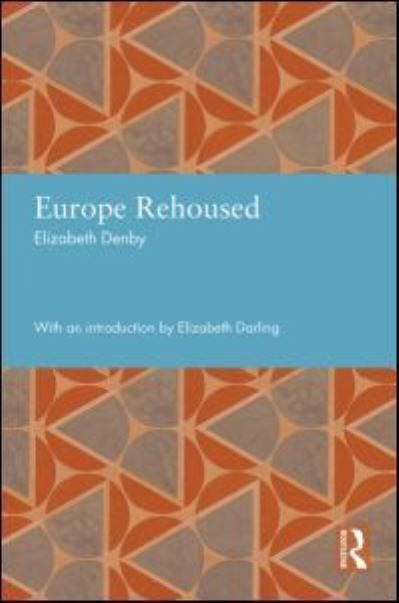
Europe Rehoused was one of the most influential housing texts of the 1930s, and is still widely cited. Written by the housing consultant Elizabeth Denby (1894-1965) it offered a survey of the nearly two decades of social housing built across Europe since the end of World War One, with the aim of informing British policy makers; as a reviewer declared 'it has a decidedly propagandist flavour'. Denby was a leading figure in housing debates in the 1930s. Adopting a line in sharp critique of what she saw as the entirely materialist approach of state housing policy, Denby advocated the incorporation of social amenities alongside well-designed and equipped flats and houses, ideally sited within urban areas; by the late 1930s she was a pioneering advocate of the concept of mixed development.
Europe Rehoused is divided into two parts. The first considered the origins of the housing problem of the inter-war decades, which Denby dated to the onset of the Industrial Revolution. She then examined the various national factors which influenced the problem: climate, post-war economy and the nature of land ownership. Finally she discussed the financial aspect: the bodies responsible for house building and the nature of the subsidies available for building. This was very much a schematic survey and the second, and largest, part of the book was devoted to individual studies of European practice, and discussed 'two winners in the War, two losers and two neutrals': Sweden, Holland, Germany, Vienna, Italy and France. This section was completed with a concluding chapter in which she compared continental work with the British system, and the lessons that could be learnt in this country from abroad.
Although Denby's book was not the only one of its sort, its importance lies in its polemical nature and its advocacy of a rehousing policy which would become widely adopted after WWII. Significant too, is that the book is the voice of a woman who had assumed a significant status as a housing expert in the inter-war decades; Walter Gropius, who wrote the introduction to the US edition of the book observed that the book 'carried the weight of perfect expertness.' Such voices have for too long been overlooked, yet Denby was formed part of a very strong tradition of women reformers who worked to re-shape the inter-war and post-war British built environment.
| ISBN: | 9780415749299 |
| Publication date: | 29th August 2014 |
| Author: | Elizabeth Denby |
| Publisher: | Routledge an imprint of Taylor and Francis |
| Format: | Hardback |
| Pagination: | 342 pages |
| Series: | Studies in International Planning History |
| Genres: |
Urban and municipal planning and policy |
Europe Rehoused was one of the most influential housing texts of the 1930s, and is still widely cited. Written by the housing consultant Elizabeth Denby (1894-1965) it offered a survey of the nearly two decades of social housing built across Europe since the end of World War One, with the aim of informing British policy makers; as a reviewer declared 'it has a decidedly propagandist flavour'. Denby was a leading figure in housing debates in the 1930s. Adopting a line in sharp critique of what she saw as the entirely materialist approach of state housing policy, Denby advocated the incorporation of social amenities alongside well-designed and equipped flats and houses, ideally sited within urban areas; by the late 1930s she was a pioneering advocate of the concept of mixed development.
Europe Rehoused is divided into two parts. The first considered the origins of the housing problem of the inter-war decades, which Denby dated to the onset of the Industrial Revolution. She then examined the various national factors which influenced the problem: climate, post-war economy and the nature of land ownership. Finally she discussed the financial aspect: the bodies responsible for house building and the nature of the subsidies available for building. This was very much a schematic survey and the second, and largest, part of the book was devoted to individual studies of European practice, and discussed 'two winners in the War, two losers and two neutrals': Sweden, Holland, Germany, Vienna, Italy and France. This section was completed with a concluding chapter in which she compared continental work with the British system, and the lessons that could be learnt in this country from abroad.
Although Denby's book was not the only one of its sort, its importance lies in its polemical nature and its advocacy of a rehousing policy which would become widely adopted after WWII. Significant too, is that the book is the voice of a woman who had assumed a significant status as a housing expert in the inter-war decades; Walter Gropius, who wrote the introduction to the US edition of the book observed that the book 'carried the weight of perfect expertness.' Such voices have for too long been overlooked, yet Denby was formed part of a very strong tradition of women reformers who worked to re-shape the inter-war and post-war British built environment.
Europe Rehoused features in the following genres: Urban and municipal planning and policy
Europe Rehoused is available in Hardback
Europe Rehoused was written by Elizabeth Denby and published by Routledge an imprint of Taylor and Francis
Europe Rehoused has 342 pages
Yes it is part of Studies in International Planning History series